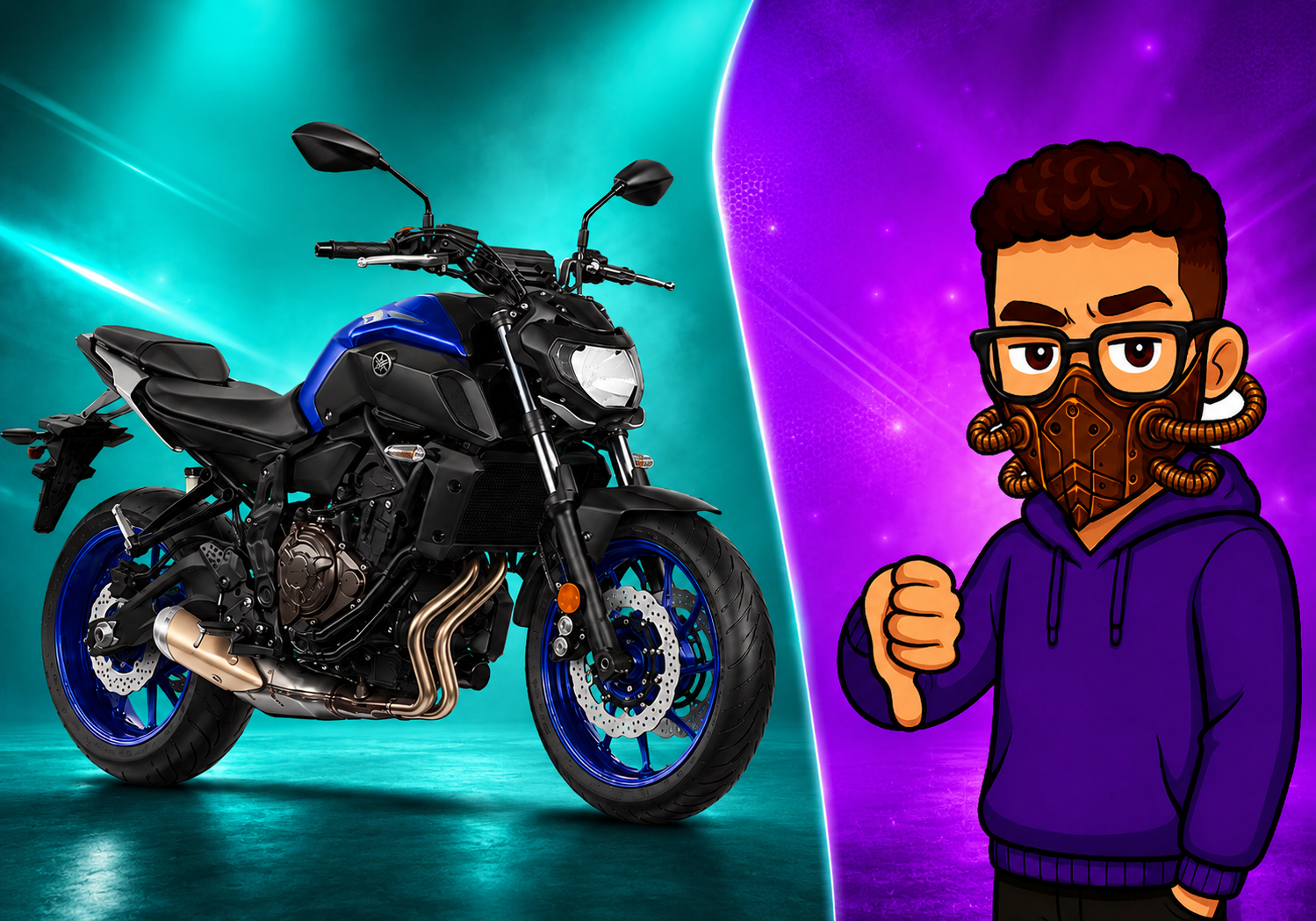

Yamaha MT-07 (2014-2025): 10 Problems Owners Have Reported
Important notice before you read. Everything below is collected from owner forums (fz07.org, fz07oc.com), published long-term reviews (MCN, RevZilla, Rider Magazine, Bennetts) and official NHTSA recall records. None of this reflects my personal opinion or my own experience with the bike. Many of these problems are exceptions, not the rule, and the MT-07 is one of the most-loved mid-size naked bikes of the last decade. But every owner deserves a year-by-year view of what’s been reported.
TL;DR
- The MT-07 (sold as FZ-07 in the USA from 2015 to 2017) has been in continuous production since 2014, with major updates in 2018, 2021 and 2024.
- Most reported issues are character traits of the CP2 parallel-twin platform rather than defects: throttle abruptness, soft suspension, right-leg heat, mid-range vibration.
- The only documented formal recall on the model itself is the 2018 chain guard recall (NHTSA 18V483000), which affected 3,493 units of the MT-07J, MT-07JC, XSR700J and XSR700JC.

The Yamaha MT-07 (called FZ-07 in the US from 2015 to 2017) is built around the 689 cc CP2 parallel-twin engine - 73 hp at 8,750 rpm, 67 Nm of torque, 184 kg kerb weight, 805 mm seat height. It’s been in continuous production since 2014 and updated meaningfully in 2018, 2021 and 2024. It’s the bike that arguably defined the modern mid-naked segment.
But every long-running platform has its known quirks. Below are 10 issues drawn from forum threads on fz07.org and fz07oc.com, published long-term reviews from MCN, RevZilla, Rider Magazine and Bennetts, and the NHTSA recall database - each tagged with the model year(s) affected. Sources are listed under every section.
Source: Goutchen - Yamaha MT-07 (2025) technical sheet
Two things worth bookmarking before you read on:
- Check the Yamaha MT-07 on the Goutchen seat-height simulator: see whether you’ll flat-foot it before you even visit a dealer.
- Full Yamaha MT-07 (2025) spec sheet on Goutchen: all the numbers in one place.
1. Snatchy off-idle throttle response (2014-2025, worst on 2014-2017 FZ-07 / MT-07)
The single most-discussed quirk of the CP2 engine. Below 3,000 rpm the throttle response is abrupt - hesitate-then-jolt - especially when picking up the throttle after a closed throttle in slow traffic. The cause is Yamaha’s EPA-mandated fuel cutoff at 0% throttle : when the injectors switch back on, the dry intake tract takes a beat to wet again, producing a jerk. It’s noticeable from 2014 to 2025, but the 2014-2017 first-generation FZ-07 / MT-07 is the worst offender because its fueling map had the abruptest transition. Common community fixes: BoosterPlug, Throttle Tamer, or a dealer ECU flash on later models.
Severity: low to moderate. Character trait, not a defect. Fixable in aftermarket.
Sources: RSR Moto - BoosterPlug 2014-2016 MT-07 · XSR 700 Forums - Throttle Tamer thread
2. Soft fork that dives under braking (2014-2024)
The stock 41 mm fork on every MT-07 from 2014 through 2024 is sprung soft and damps lightly. MCN’s 2014-2018 review and RevZilla’s 2021 first ride both flag it as the bike’s weakest dynamic point : under hard braking the fork dives heavily, and over broken tarmac the front feels vague. The 2021 facelift updated dampers slightly but the character carries through. Aftermarket spring and emulator kits (TEC, YSS, Progressive Suspension) are widely used.
Severity: low to moderate. Upgradable for €200-400.
Sources: MCN - 2014-2018 MT-07 review · TEC Bike Parts - MT-07 fork upgrade kit · Progressive Suspension - MT-07/XSR700 upgrade
3. Soft rear shock with limited damping control (2014-2024)
Same story at the back. The stock shock is preload-adjustable only (no compression or rebound damping adjustment), and the spring rate is tuned for light solo riders. Heavier owners and two-up touring riders consistently report the rear bottoms on bumps and rebounds aggressively over washboard surfaces. RevZilla’s 2021 review notes the rear “rebounds hard enough to throw riders out of the seat” over broken roads. Replacement shocks from Hagon, YSS, Wilbers and Öhlins are common fits across 2014-2024 models.
Severity: low to moderate. Upgradable.
Sources: RevZilla - 2021 MT-07 first ride · Yamaha MT-07 forum suspension threads
4. Wooden front brake feel (2014-2020, slightly improved 2021+)
Owners on fz07.org and forum-cited MCN reviews of the 2014-2020 MT-07 / FZ-07 describe the front brake as having little initial bite and a wooden feel. The 2021 facelift increased the front rotors from 282 mm to 298 mm and added a slightly larger master cylinder, which improved bite but not by much - the 2021-2024 models still get described as soft. Switching to sintered or EBC HH pads and refreshing the brake fluid every 2 years are the most-recommended fixes.
👉 Try the Yamaha MT-07 on the Goutchen seat-height simulator before you commit.
Severity: moderate. Pad upgrade transforms it.
Sources: MCN - 2021-2024 MT-07 review · Bennetts BikeSocial - 2018 MT-07 review

5. 2018 chain guard recall (NHTSA 18V483000)
The only formal recall on the MT-07 platform itself. In August 2018, Yamaha recalled 3,493 units of the 2018 MT-07J, MT-07JC, XSR700J and XSR700JC for chain guard bolts that may loosen. If the bolts back out, the chain guard can contact the drive chain and break, potentially causing loss of control. Yamaha campaign 990120, NHTSA campaign 18V483000. Dealers replaced both mounting bolts free of charge. If you’re buying a 2018-model MT-07 used, check the recall has been completed against the VIN.
Severity: high. Verify VIN against the recall before purchase if used.
Sources: Ultimate Motorcycling - 2018 MT-07 chain guard recall · OEMDTC - 990120 chain guard bolts may loosen · RideApart - 2018 MT-07 / XSR700 recall
6. Engine cuts out or surges at idle (most reported on 2014-2016 first-gen)
Multiple 2014-2016 FZ-07 / MT-07 owners on fz07.org report the engine surging or cutting out at idle, especially when warm or in hot weather. The root cause is the ECU running the engine lean at idle to meet emissions, combined with throttle bodies that have drifted out of synchronization. Yamaha-dealer throttle body sync (typically required at the 16,000 km service) plus a stage-one ECU map fix it for most owners. Later 2018+ revisions reduced but didn’t eliminate the issue.
Severity: moderate. Service-procedure fix.
Sources: MotorAndWheels - MT-07 common problems · FZ-07 Owners Club - common problems
7. Battery parasitic drain when sitting (most reported on 2014-2017 first-gen)
A pattern across 2014-2017 FZ-07 / MT-07 owner threads : the bike’s battery dies within 1-2 weeks of inactivity. The cause is electrical components continuing to draw a small amount of current when the ignition is off. The standard community fix is fitting a battery tender (Optimate, CTEK) whenever the bike sits for more than a few days. 2018+ models still benefit from a tender but the drain is less aggressive on later wiring harnesses.
Severity: moderate. Battery tender fixes it.
Sources: Engine Patrol - 7 common MT-07 problems · MotorAndWheels - MT-07 common problems
8. Stator and regulator-rectifier vulnerability (platform-wide 2014-2024)
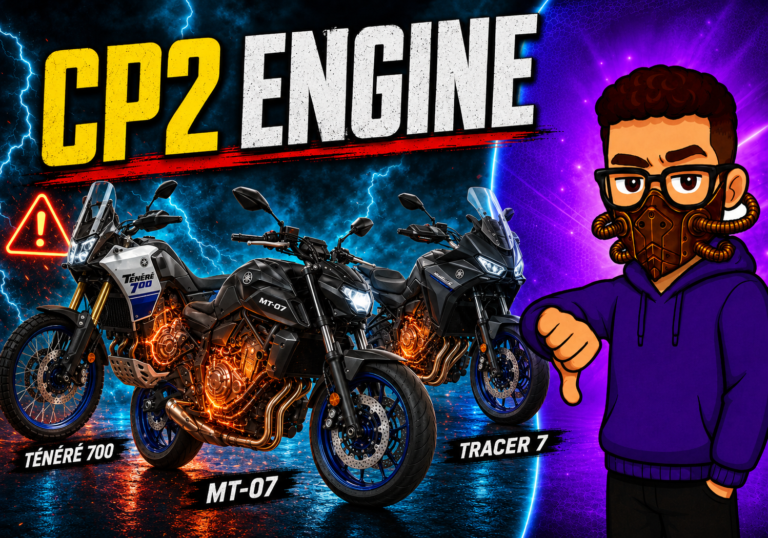
A documented platform-wide weakness across the 2014-2024 MT-07 / FZ-07 / XSR700 / Tracer 700 / Ténéré 700 / YZF-R7 family (they all share the CP2 platform). Stators and regulator-rectifiers can fail before 50,000 km, with symptoms including dim lights, hard starts, and a dead battery on a fully-charged-yesterday bike. Many owners pre-emptively switch to a Shindengen FH020AA or similar MOSFET regulator-rectifier when they have the bike apart for any reason.
Severity: moderate to high. Manageable with planned maintenance; failure can strand you.
Sources: AmotoPart - MT-07 stator / R&R 2014-2024 fitment · ADVrider - regulator-rectifier failure symptoms
9. Excess heat on the right leg from exhaust (all years 2014-2025)
The CP2 engine routes its exhaust headers under the engine on the right side, and the resulting heat under the right thigh is a well-known characteristic on every model year from 2014 to 2025. Owners report visibly red exhaust pipes after stop-and-go traffic, and one fz07.org thread documents burn marks on rain pants. Community solutions : exhaust wrap, ceramic coating, or simply learning to keep weight on the pegs in slow traffic. It’s a packaging compromise, not a defect.
Severity: moderate. Manageable with wraps or coatings.
Sources: fz07.org - one exhaust pipe getting visibly red · MotorAndWheels - MT-07 heat complaints
10. Vibration through the bars in the 4,500-5,500 rpm zone (all years, CP2 engine character)
The CP2’s crossplane parallel-twin firing order gives it character at the cost of a buzzy mid-range. Owners across 2014-2025 report vibration through the handlebars peaking around 4,500-5,500 rpm - exactly where the bike sits at motorway cruising speeds in top gear. Bar-end weights (heavier than stock), aftermarket bar risers with rubber isolators, and gel grip overlays are the common community workarounds.
Severity: low to moderate. Character trait. Easy mitigations exist.
Sources: fz07.org - vibration discussion threads · MCN - 2014-2018 MT-07 review
So, should you still buy a Yamaha MT-07?
Yes - and that’s not a hedge. The MT-07 / FZ-07 has been in production for over a decade across 2014 to 2025 and has earned its reputation as one of the best-value, most-fun mid-naked bikes ever made. The 689 cc CP2 engine is a known good motor, the bike is light (184 kg), the seat is reasonable for most riders at 805 mm, and parts are plentiful and cheap.
Every issue on this list is either a known character trait of the platform (throttle, suspension, heat, vibration) or a documented service item that has well-established fixes. The 2018 chain guard recall is the only formal safety recall and it’s been actively serviced since August 2018.
If you’re shopping new for a 2025 MT-07, you’re getting the benefit of every quirk Yamaha has improved over a decade. If you’re shopping used for a 2014-2017 FZ-07 / MT-07, expect to spend €200-500 on a fork upgrade, a battery tender, and maybe a throttle response module. The bike will outlast the budget.
Useful Goutchen links to keep handy: