
Royal Enfield: 10 Things to Know About India's Heritage Brand

Photo: Hu Nhu / Wikimedia Commons (CC-BY-SA 4.0)
Royal Enfield is the only motorcycle brand in the world whose story bridges the early days of British industry, the postwar Indian Army, and the modern global mid-displacement segment - all from the same continuous brand line. Founded in 1901 in the English town of Redditch as a firearms-components workshop, Royal Enfield moved its motorcycle production to India in 1955 to meet Indian Army orders, then closed its UK operations in 1970 and became a purely Indian brand. Today, under Eicher Motors' ownership since 1994, Royal Enfield is the world's largest mid-displacement motorcycle manufacturer, with a UK technology centre, an Indian manufacturing base, and exports to over 60 countries.
This post is the deep-dive companion to the "10 Indian Motorcycle Brands You Should Know" hub. The ten moments below trace how a Victorian-era English arms-component maker turned into one of India's most successful global brands.
TL;DR
- Founded 1901 in Redditch, England as a firearms-component maker - the "Made Like a Gun" motto literally reflects the brand's military supply history.
- Production moved to India in 1955 for Indian Army orders, UK operations closed in 1970, and Eicher Motors acquired the brand in 1994.
- World's largest mid-displacement motorcycle manufacturer, with the 650 twins, Himalayan 450, and 350 range driving global growth, and a UK Technology Centre in Bruntingthorpe supporting the engineering.
1. Founded in 1901 in Redditch, England
The company that became Royal Enfield was founded as George Townsend & Co. in Redditch, Worcestershire in 1893, producing sewing-machine and bicycle parts. In 1901 it built its first motorcycle - a 1.5 hp engine mounted on a bicycle frame. The "Royal" in the name came from a Royal Small Arms Factory contract in Enfield (north London), which supplied precision rifle parts - the brand-name "Royal Enfield" entered formal use the same year. The slogan "Made Like a Gun" appeared shortly afterwards, deliberately invoking the firearms-grade engineering quality that defined the Redditch operation through the early 20th century.
Sources: Royal Enfield - Heritage; Wikipedia - Royal Enfield.
2. The "Made Like a Gun" motto - literal, not metaphorical
Royal Enfield supplied motorcycles to the British military in both World Wars. In WWI the company delivered substantial numbers of dispatch-rider machines and sidecar-mounted Vickers gun units. In WWII the most famous product was the "Flying Flea" RE/WD-RE, a 125cc 2-stroke lightweight that was dropped by parachute behind enemy lines for use by airborne troops. The "Made Like a Gun" motto referred to the actual firearms-grade tolerances Royal Enfield applied to its engine and frame manufacture - the same machine tools and quality-control processes that the Redditch factory used for ordnance contracts were reused for motorcycle production.
Sources: Royal Enfield - Heritage; Wikipedia - WD/RE Flying Flea.
3. The Bullet (1932) - the longest-running motorcycle nameplate

Photo: Thruxton / Wikimedia Commons (CC-BY 3.0)
The Royal Enfield Bullet was introduced in 1932 - a single-cylinder, four-stroke design that defined Royal Enfield's character for the next ninety-plus years. The Bullet is the longest-running motorcycle nameplate in continuous production anywhere in the world. The fundamental architecture (long-stroke single, exposed pushrods, separate gearbox, robust frame) survived essentially unchanged from 1932 to 2008. The modern UCE-engined Bullet 350 (still in production today) is a direct descendant. Even the most ardent vintage purist would recognise a 1955 Bullet alongside a 2026 Bullet as obvious cousins.
Sources: Royal Enfield - Bullet 350; Wikipedia - Royal Enfield Bullet.
4. Production moved to India (1955)

Photo: Javier Perez Montes / Wikimedia Commons (CC-BY-SA 4.0)
In 1955 the Indian Army placed an order for 800 Bullet 350s for border patrol duty. The order was too big for the Redditch factory to fulfil from England, so a joint venture was set up with the Madras-based Madras Motors to assemble Bullets in India. The new factory in Chennai (then Madras) was, at first, just doing kit assembly. Within a few years it had taken over component manufacture as well, and by 1962 the Indian operation was producing complete motorcycles from local parts. The Madras factory still operates today and is the brand's principal manufacturing site.
Sources: Royal Enfield - Heritage; Wikipedia - Royal Enfield.
5. UK operations close (1970)
Royal Enfield UK suffered the same problems as the rest of the British motorcycle industry through the 1960s - undercapitalised, out-engineered by the Japanese, hit by management failure, and ultimately financially unviable. The Redditch factory closed in 1967 and the broader UK operation wound down by 1970. From that point Royal Enfield was, paradoxically, a fully Indian brand that still owned a famous British name. The Indian Madras factory continued building Bullets through the 1970s and 80s, mostly for the Indian domestic market and the Indian Army, with very limited exports. The brand survived the global motorcycle restructuring almost by accident - its small Indian operation was uneconomic enough to not be worth restructuring out of existence.
Sources: Royal Enfield - Heritage; Wikipedia - Royal Enfield.
6. Eicher Motors acquires Royal Enfield (1994)
In 1994 the Indian conglomerate Eicher Motors acquired Royal Enfield from its previous Indian owner. The acquisition was, at the time, a modest commercial transaction. The transformation came after Siddhartha Lal joined Eicher in 2000 and took personal interest in the motorcycle subsidiary. Lal's vision was clear: keep the heritage character that made the brand recognisable, but fix the engineering quality and modernise the platform. The next two decades were a deliberate, slow rebuild - new engines, new factories, new dealer network, new brand identity, new export programme - that took Royal Enfield from a struggling Indian niche manufacturer to a global mid-displacement category leader. Lal has remained the brand's strategic architect since 2000.
Sources: Royal Enfield - Heritage; Wikipedia - Eicher Motors.
7. The Unit Construction Engine (UCE) and global ambitions (2009)
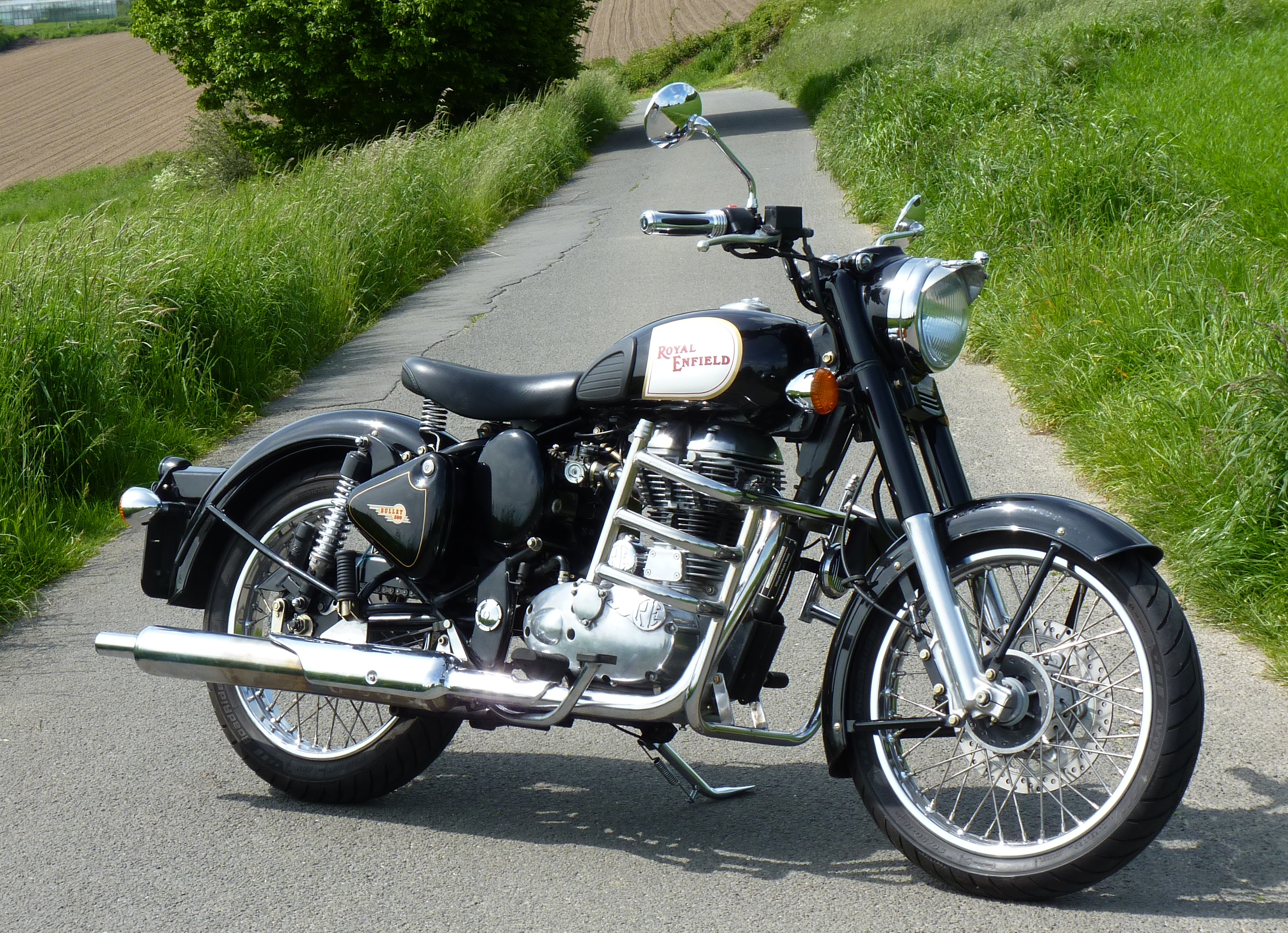
Photo: Thgrube / Wikimedia Commons (CC-BY-SA 3.0)
In 2009 Royal Enfield launched the Unit Construction Engine (UCE) - a modern single-cylinder design with the engine and gearbox housed in a single case, fuel injection, and emissions compliance to global standards. The UCE replaced the antique cast-iron engine that had survived from the 1932 Bullet design. The UCE was the platform that finally allowed Royal Enfield to sell its bikes in markets like the UK, EU, US, and Australia without grey-market workarounds. The 2013 Continental GT 535 was the first true global Royal Enfield product since the 1970s, marketed as a cafe-racer aimed at Western markets and developed in partnership with the brand's newly established UK Technology Centre.
Sources: Royal Enfield - Heritage; Wikipedia - Continental GT.
8. The 650 twins (2018) - the segment game-changer
In 2018 Royal Enfield launched the Interceptor 650 and Continental GT 650 at game-changing prices. The bikes were designed at the Royal Enfield UK Technology Centre in Bruntingthorpe (Leicestershire), engineered around a new air-cooled parallel-twin 648cc engine producing 47 hp. The launch price - well under €7,000 in Europe and around $5,800 in the US - undercut every comparable mid-displacement parallel-twin from Japan or Europe by several thousand. The 650 twins single-handedly redefined what entry-mid-displacement pricing looked like, and within three years they were Royal Enfield's biggest export-market success since the Bullet. The platform has since expanded to the Super Meteor 650 cruiser, the Shotgun 650 bobber, and (rumoured) a 650 ADV.
Sources: Royal Enfield - Interceptor 650; Wikipedia - Interceptor 650.
9. The Himalayan series (2016) and Himalayan 450 (2024)

Photo: Mr.choppers / Wikimedia Commons (CC-BY-SA 3.0)
The original Himalayan launched in 2016, designed for the small-adventure category - an affordable, lightweight, genuinely off-road-capable ADV bike that had no real competitor in its price range. The first-generation 411cc Himalayan was charismatic but engineering-light. The Himalayan 450, launched in 2024, replaced it with a clean-sheet platform: the new liquid-cooled Sherpa 450 single-cylinder engine, longer-travel suspension, a much more capable chassis, ride modes, and a TFT instrument cluster. The Himalayan 450 was developed jointly by the Bruntingthorpe UK Technology Centre and the Chennai engineering team, and is Royal Enfield's most thoroughly modern model to date.
Sources: Royal Enfield - Himalayan 450; Wikipedia - Himalayan.
10. Modern Royal Enfield - global mid-displacement leader
Royal Enfield today is, by some measures, the most successful Indian motorcycle export brand and the world's largest mid-displacement (250cc-750cc) motorcycle manufacturer. The combined output of the 350 family (Classic 350, Hunter 350, Bullet 350, Meteor 350), the 650 twin family (Interceptor 650, Continental GT 650, Super Meteor 650, Shotgun 650), and the Himalayan 450 is over a million motorcycles per year, sold in over 60 countries. The brand has been deliberately expanding into racing (the Continental GT Cup), into electric (the Flying Flea EV concept revealed at EICMA 2024), and into new heritage-roadster categories (the recently launched Guerilla 450 and a constantly evolving accessories ecosystem). Royal Enfield is now a globally relevant motorcycle brand by every metric, and is the clearest proof that an Indian-built product can compete at parity with Japanese and European rivals.
Sources: Royal Enfield - Models; Wikipedia - Royal Enfield.
A hundred and twenty-four years in, Royal Enfield has done what almost no other heritage motorcycle brand has managed: it has survived ownership changes across two continents, the collapse of the British motorcycle industry, decades of low-volume Indian-domestic-only operation, and emerged as a global brand whose product range is taken seriously by people who would never previously have considered an Indian-built motorcycle. The combination of authentic heritage (the longest-running motorcycle nameplate in the world is the Bullet), modern engineering (the 650 twins, the Himalayan 450, the Sherpa engine), competitive pricing, and a strategic UK technology presence is rare enough to make Royal Enfield the most globally relevant Indian motorcycle brand by a wide margin.
Useful Goutchen links
- Check Royal Enfield models on the Goutchen seat-height simulator - filter by brand to see which RE models are indexed.
- 10 Indian Motorcycle Brands You Should Know - the hub post that contextualises Royal Enfield alongside Bajaj, TVS, Hero, and the Indian electric pioneers.