
10 Iconic Japanese Motorcycles That Changed Motorcycling
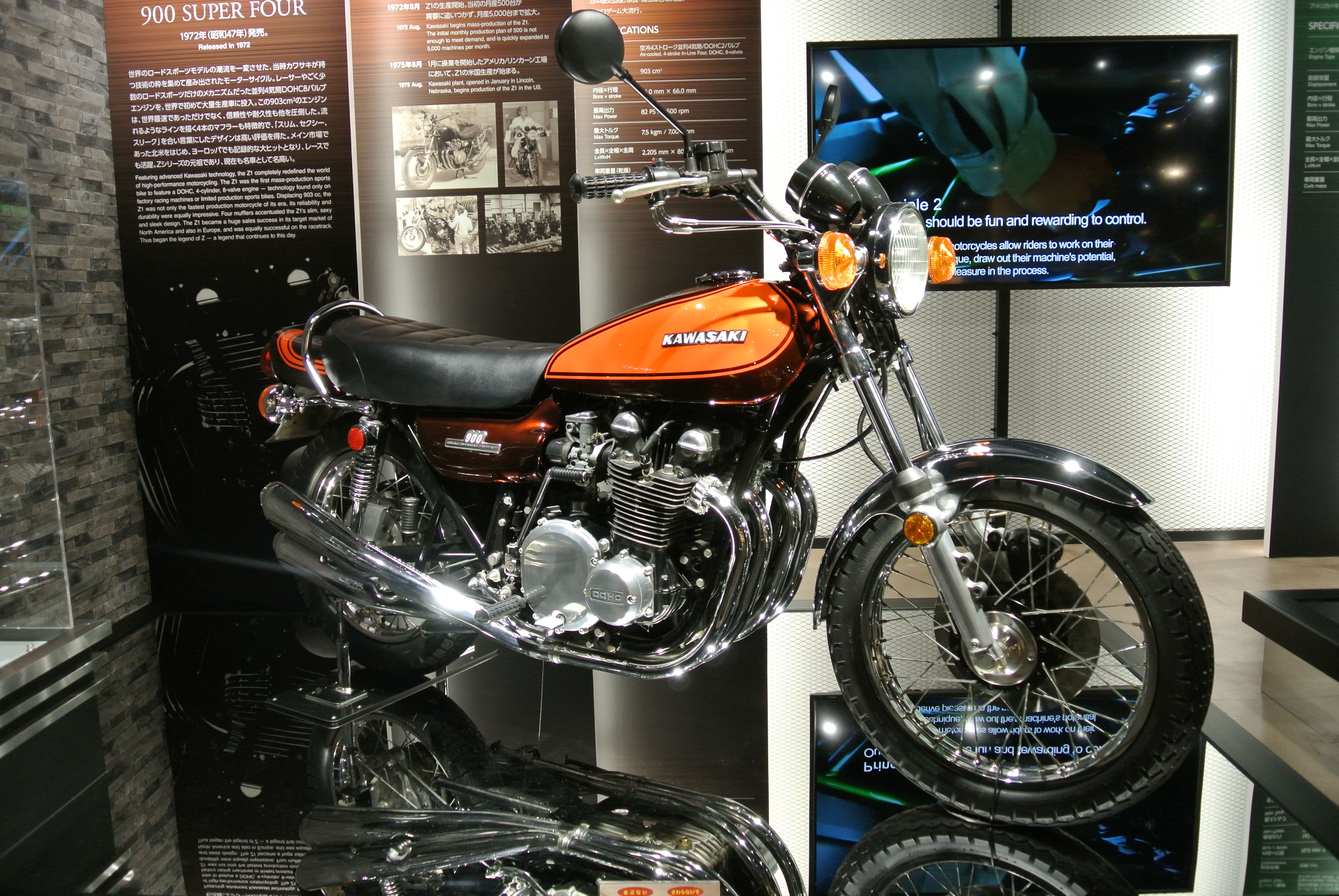
Photo: Rainmaker47 / Wikimedia Commons (CC-BY-SA 4.0)
Ten motorcycles, one per major era, that defined what Japanese motorcycles could be - and what motorcycling in general looked like in the decade after each launched. From the 1958 Super Cub that transformed global mobility to the 2015 supercharged Ninja H2 that reasserted Japan's engineering ambition, each bike on this list either invented or redefined an entire category. The list is chronological. The categories covered are commuter, superbike, race-replica, muscle bike, homologation special, supersport, hyperbike, and supercharged production.
This post is a companion to our Big Four Japanese hub. All four major brands appear below, with Honda taking three entries (Super Cub, CB750, Fireblade), a fourth specialty pick (RC30), and the rest spread across Kawasaki, Suzuki, and Yamaha.
TL;DR
- Ten motorcycles, one per major era, that defined what Japanese motorcycles could be - from the 1958 Super Cub transforming global mobility to the 2015 supercharged Ninja H2 reasserting Japan's engineering ambition.
- All four major brands appear: Honda dominates with three entries (Super Cub, CB750, Fireblade), with the RC30 as a fourth specialty pick.
- Each bike on the list either invented or redefined an entire category: commuter, superbike, race-replica, muscle bike, homologation, supersport, hyperbike, supercharged.
1. Honda Super Cub C100 (1958)

Photo: Mj-bird / Wikimedia Commons (CC-BY-SA 3.0)
Significance: The motorcycle that transformed personal mobility globally. Specs: 49cc OHV single, 4.5 hp, three-speed automatic clutch, step-through frame. Why it changed everything: The Super Cub was the first motorcycle deliberately designed to be ridden by ordinary people - women in skirts, businessmen in suits, anyone without prior motorcycle experience. The automatic clutch removed the riding-skill barrier. The step-through frame removed the dress-code barrier. The 50cc engine class meant no special license. Over 100 million units produced across all variants - the most-produced motor vehicle in history. Influence: Modern scooters, electric two-wheelers, and the global commuter motorcycle segment all trace back to the Super Cub.
2. Honda CB750 Four (1969)

Photo: Ronoli / Wikimedia Commons (CC-BY 2.0)
Significance: Invented the modern superbike, ended the British motorcycle industry. Specs: 736cc SOHC inline-four, 67 hp, five-speed, front disc brake, electric start, $1,495 launch price. Why it changed everything: The CB750 brought together features the British couldn't match at the price: four-cylinder smoothness, disc-brake stopping power, push-button starting, mass-production reliability. The combination made Triumph, BSA, and Norton suddenly look outdated overnight. Influence: Every modern inline-four sportbike from the Yamaha YZF-R1 to the Suzuki GSX-R1000 traces back to the CB750 platform philosophy.
3. Kawasaki Z1 (1972)
Photo: Rainmaker47 / Wikimedia Commons (CC-BY-SA 4.0)
Significance: Japan's escalation of the CB750 era, set the inline-four performance standard for two decades. Specs: 903cc DOHC inline-four (Kawasaki's first), 82 hp, top speed over 200 km/h. Why it changed everything: Kawasaki's response to the CB750 went bigger - DOHC instead of SOHC, more displacement, more power - and the Z1 instantly redefined what "Japanese performance motorcycle" meant. The bike was originally planned at 750cc to match Honda, but Kawasaki escalated to 900cc to deliver something unambiguously faster. Influence: The Z1 lineage continues today through the Z900, Z H2, and Ninja platforms - the longest-running Japanese performance motorcycle family.
4. Suzuki Katana 1100 (1981)

Photo: Rainmaker47 / Wikimedia Commons (CC-BY-SA 3.0)
Significance: Changed what Japanese motorcycles could look like. Specs: 1075cc DOHC inline-four, 111 hp, half-fairing, distinctive nose. Why it changed everything: Hans Muth (the German designer responsible for the BMW R 90 S) was commissioned by Suzuki to design something visually radical. The Katana 1100's silver-and-red bodywork, integrated headlight cowl, and sharp angular surfaces broke Japanese visual conventions entirely. It looked like nothing else on the road in 1981. Influence: Modern Japanese sport-bike design language - especially the aggressive angular fairings used by Suzuki, Yamaha, and Honda since the 1990s - traces back to the Katana.
5. Suzuki GSX-R750 (1985)

Photo: Rainmaker47 / Wikimedia Commons (CC-BY-SA 3.0) - 1985 model at Suzuki History Museum
Significance: Invented the modern race-replica sportbike. Specs: 749cc DOHC inline-four (oil-cooled), 100 hp, aluminium twin-spar frame, dry weight 179 kg, full racing fairing. Why it changed everything: Before the GSX-R750, sportbikes were street motorcycles with some sporting intent. Suzuki built a road-legal race bike - aluminium frame, full fairing, riding position, weight target, and componentry all derived from endurance racing. No previous Japanese motorcycle had compressed race-grade engineering this aggressively for the street. Influence: The entire modern supersport segment (CBR, R1, YZF-R, ZX-10R, Panigale V4, RSV4) traces directly back to the GSX-R750's "race-replica" philosophy.
Source: Wikipedia - Suzuki GSX-R750.
6. Yamaha V-Max VMX12 (1985)

Photo: Ramsha Darbha / Wikimedia Commons (CC-BY 2.0)
Significance: The original muscle bike. Specs: 1198cc 70-degree V4, 145 hp, top speed 235 km/h, designed primarily for straight-line acceleration. Why it changed everything: Yamaha designed the V-Max around a single mission: raw, brutal acceleration. No other purpose. Cornering, comfort, touring - all secondary. The V-Max defined a new category, the muscle bike, that has been reinterpreted in the V-Max 1700 (2009-2017), the Honda Valkyrie F6C, and various current cruiser-naked hybrids. Influence: Modern muscle-bike products like the Triumph Rocket 3 and Ducati Diavel all trace their conceptual lineage back to the original V-Max.
7. Honda RC30 / VFR750R (1987)

Photo: Cjp24 / Wikimedia Commons (CC-BY-SA 4.0)
Significance: The homologation special that won the inaugural WSBK championship. Specs: 748cc V4 (gear-driven cams, V4 firing order), 112 hp, dry weight 185 kg, single-sided swing-arm. Why it changed everything: The RC30 was built specifically to qualify for the new World Superbike Championship under FIM homologation rules. Honda built fewer than 3,000 units worldwide. Fred Merkel won the 1988 inaugural WSBK on an RC30, Carl Fogarty won the F1 TT class on one, and the bike's combination of V4 engineering, single-sided swing-arm, and obsessive race-quality construction set the template for the homologation-special category. Influence: Used examples now trade for £40,000-80,000 in restored condition - one of the most collectible Japanese motorcycles ever made.
Source: Wikipedia - Honda RC30.
8. Honda CBR900RR Fireblade (1992)

Photo: PekePON / Wikimedia Commons (CC-BY-SA 3.0)
Significance: Compressed liter-class power into a 600-class chassis, invented the modern supersport approach to weight. Specs: 893cc DOHC inline-four, 122 hp, dry weight 185 kg (Yamaha FZR1000 was 209 kg). Why it changed everything: Tadao Baba's "total control" philosophy treated weight and dimensions as more important than peak power. The CBR900RR shipped weighing less than the contemporary 600cc supersports, with liter-class power. Every supersport sold since 1992 follows this philosophy. Influence: The Fireblade philosophy became universal: weight, weight distribution, and chassis precision are the variables modern supersport engineers optimise around. Peak power is secondary.
9. Suzuki Hayabusa GSX1300R (1999)

Photo: Bob Adams / Wikimedia Commons (CC-BY-SA 2.0)
Significance: The world's fastest production motorcycle at launch. Specs: 1299cc DOHC inline-four, 175 hp at launch, top speed approximately 312 km/h. Why it changed everything: The Hayabusa was specifically engineered to dethrone the Honda CBR1100XX Super Blackbird as the world's fastest production motorcycle. Aerodynamics were the primary engineering target. The Hayabusa achieved an unrestricted top speed that scared the industry into the manufacturer "gentleman's agreement" capping production-bike top speeds at approximately 300 km/h - an agreement still in effect 26 years later. Influence: The Hayabusa remains in production with the 2021 third-generation update. It also defined the "hyperbike" or "hypersport-tourer" category.
10. Kawasaki Ninja H2 / H2R (2015)
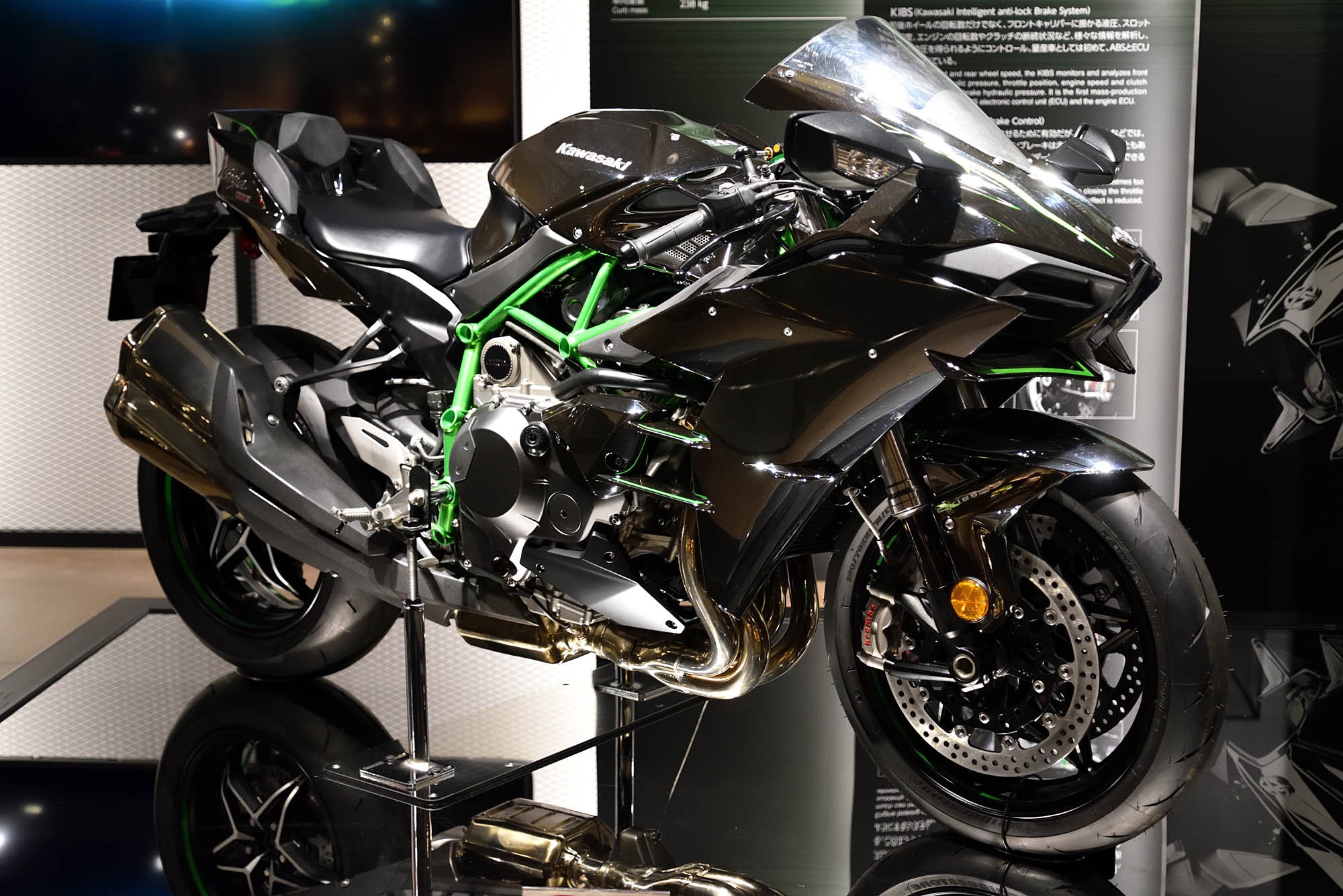
Photo: Rikita / Wikimedia Commons (CC-BY-SA 4.0)
Significance: The first supercharged production motorcycle. Specs: 998cc supercharged inline-four, 228 hp (H2 road version) or 326 hp (H2R track-only), specially developed by Kawasaki Heavy Industries' aerospace and gas turbine divisions. Why it changed everything: By 2015, Japanese motorcycle dominance was being questioned - Ducati, KTM, Aprilia, and the European brands were taking serious share. Kawasaki built the H2 explicitly to prove Japan could still produce world-shaking motorcycles. The supercharger was a deliberate engineering statement: nobody else was doing it, and only a conglomerate as large as Kawasaki Heavy Industries could draw on the aerospace and gas-turbine engineering needed to make it work. Influence: Honda's V3 turbocharged concept (shown at EICMA 2025) is the most direct response - the next generation of Japanese performance engineering.
Step back and look at the ten bikes together. The chronology spans 57 years - from a 49cc commuter in 1958 to a 326-hp supercharged track machine in 2015. The pattern is consistent: each bike answered a specific market gap or engineering challenge, executed it more aggressively than competitors expected, and reshaped what the segment could be. Honda dominates the list with three core entries (Super Cub, CB750, Fireblade) and the RC30 as a specialty pick - reflecting Honda's central role in defining what Japanese motorcycles could be. Suzuki's GSX-R750, Hayabusa, and Katana cover three different revolutions (race-replica, hyperbike, design). Yamaha's V-Max defined a category that didn't previously exist. Kawasaki's Z1 and Ninja H2 bookend the inline-four performance era with maximum aggression.