
Electric Motorcycle Batteries Explained: Chemistry, Range, Lifespan

Photo: Sevenethics / Wikimedia Commons (CC0). 18650 (left) and 21700 (right) cylindrical Li-ion cells - the two cell formats inside most EV motorcycle packs.
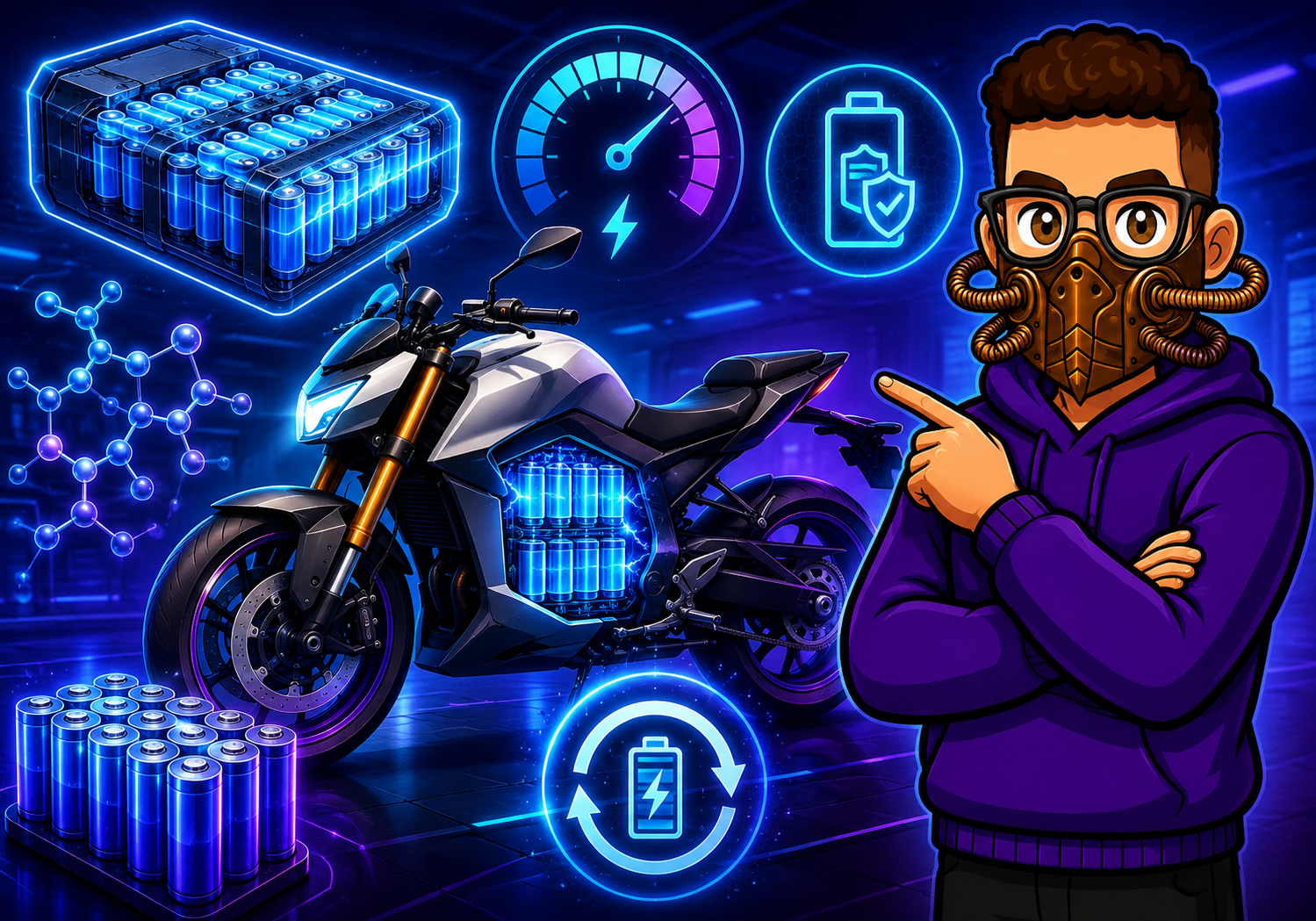
The battery is the single most consequential component on any electric motorcycle. It decides range, charge time, weight distribution, top speed, lifespan, warranty risk, and cost. It is also the component most riders understand least well - manufacturers quote kWh capacity, claim mileage range, and leave the rest opaque. This explainer covers the ten things every electric motorcycle buyer should understand about the battery pack under the seat: chemistry, cell format, voltage architecture, cooling, BMS, lifespan, the 2026 solid-state breakthrough, swappable systems, and safety.
For the bigger picture see our 2026 electric motorcycle buyer's guide; for the most consequential 2026 battery announcement see our piece on Ducati's solid-state shock; and for the Japanese OEM perspective see Honda's first electric motorcycle, the WN7.
TL;DR
- In 2026, almost every production electric motorcycle still uses lithium-ion chemistry in cylindrical 18650 or 21700 cell formats, with capacity from 3.6 kWh (small commuter) to 22.5 kWh (Energica Experia tourer).
- Cooling, voltage architecture, and the Battery Management System (BMS) matter as much as raw kWh - the same cells in a better-managed pack will outlast the same cells in a poorly-managed pack by 30-50%.
- The 2026 production milestones are Verge's solid-state pack (claimed Q1 2026 production) and Ducati's solid-state development reveal - if either lands cleanly, the lithium-ion era starts ending faster than expected.
1. Lithium-ion is still the standard chemistry in 2026
Almost every production electric motorcycle on sale in 2026 uses lithium-ion chemistry. Within lithium-ion there are multiple sub-chemistries: NMC (Lithium Nickel Manganese Cobalt Oxide - the most common for performance motorcycles), NCA (Lithium Nickel Cobalt Aluminium Oxide - used by some premium brands for higher energy density), and LFP (Lithium Iron Phosphate - lower energy density but longer cycle life and better thermal stability, used in some commuter EVs). NMC gives the highest typical energy density at around 200-260 Wh/kg at cell level in 2026 production cells.
Sources: Wikipedia - Lithium-ion battery; Wikipedia - Battery types comparison.
2. Cell formats - cylindrical, pouch, prismatic
There are three main cell physical formats used in EV motorcycles:
- Cylindrical 18650 (18 mm diameter, 65 mm length) - the original Tesla Roadster format and the most common cell in earlier-generation EV motorcycles. Zero Motorcycles' original Z-Force packs used 18650 cells.
- Cylindrical 21700 (21 mm diameter, 70 mm length) - higher energy density per cell, fewer cells needed per pack, lower interconnect complexity. The dominant cylindrical format in 2026 production motorcycles.
- Pouch cells - flat foil-pouch cells that can be packed into custom shapes. Higher gravimetric energy density but lower mechanical robustness; usually require a more substantial outer enclosure.
- Prismatic cells - rigid rectangular metal-cased cells. Higher volumetric efficiency than cylindrical, often used in automotive packs. Less common in motorcycles because the smaller pack volumes make cylindrical packaging tradeoffs more attractive.
Sources: Wikipedia - 18650 battery; Wikipedia - 21700 battery.
3. Energy density - the kWh per kg number that decides range
A motorcycle battery pack in 2026 typically delivers 130-180 Wh per kg at the pack level (cell-level density is higher, but the BMS, cooling, casing, and structural elements add weight). A 17 kWh pack therefore weighs roughly 95-130 kg - which is why electric motorcycles are usually 30-60 kg heavier than equivalent combustion bikes. Pack energy density has improved roughly 5-7% per year through the 2020s, which is why the same physical pack size in 2026 typically carries 20-25% more usable energy than the equivalent 2020 pack. The improvement comes from incremental cell-chemistry gains (higher nickel content, better cathode coatings), not from any breakthrough.
Sources: Wikipedia - Lithium-ion energy density; Zero Motorcycles - Z-Force technology.
4. Voltage architecture - low (~100V) vs high (400V+)
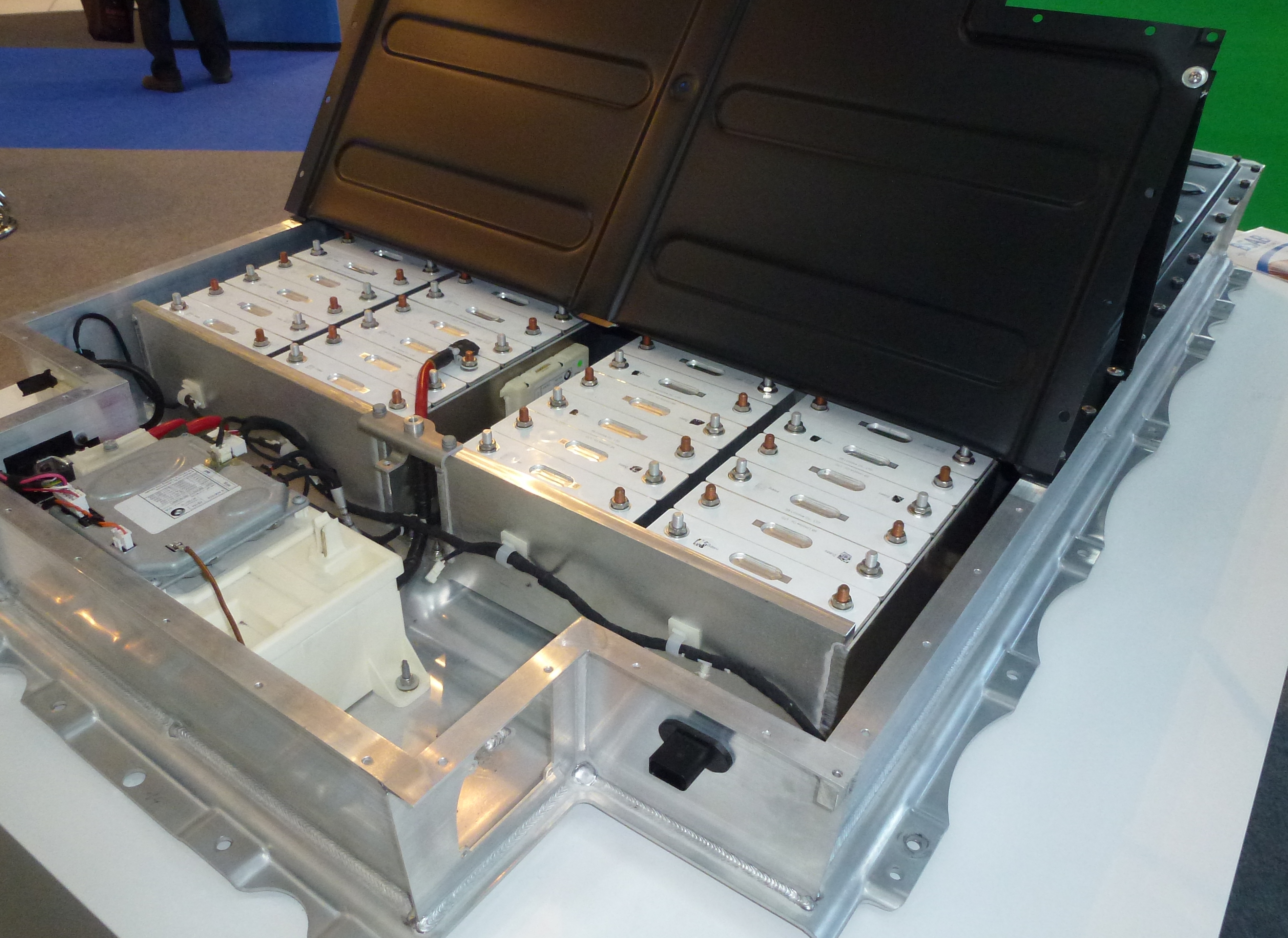
Photo: RudolfSimon / Wikimedia Commons (CC-BY-SA 3.0). BMW i3 battery pack - illustrative of automotive pack architecture principles that scale down to motorcycle packs.
Pack voltage drives the design of motor controller, cabling, and charging hardware. Lower-voltage motorcycle packs (around 100-150V) are simpler and cheaper but limit peak power and prevent CCS DC fast charging at meaningful rates. Higher-voltage packs (300-400V+) enable DC fast charging at 24 kW (Energica Experia) or 100+ kW (some prototype concepts), and support higher motor peak power. The Verge Donut Motor runs on a 360V pack. The trade-off is more rigorous insulation requirements and higher cost.
Sources: Energica Experia specifications; Verge TS Pro specifications.
5. Cooling - air-cooled vs liquid-cooled
Battery cooling architecture matters more than most spec sheets admit. Air-cooled packs (Zero's Z-Force, most lightweight commuters) are simpler, lower cost, and have no liquid loop to fail - but heat dissipation is limited, so fast charging and sustained high-load operation are thermally constrained. Liquid-cooled packs (Energica, LiveWire, Verge) circulate coolant through cold plates contacting the cells, allowing sustained higher-power operation and faster DC charging without thermal de-rate, at the cost of greater system complexity and weight. The cooling architecture is the single biggest determinant of how the bike behaves on a hot day at sustained high speeds.
Sources: Zero - Z-Force air cooling; Energica - liquid cooling.
6. The Battery Management System (BMS)
The BMS is the embedded controller that monitors voltage, current, and temperature across each cell or cell group in the pack. The BMS balances cells (so all cells discharge and charge at equal rates), prevents overcharge and over-discharge, isolates failed cells, and manages thermal limits. A high-quality BMS can extend pack lifespan by 30-50% versus a poorly-implemented one with the same cells. The BMS is also the component most invisible to the customer - a buyer sees kWh capacity and range estimates, but the BMS firmware quality is what determines whether year-five range is 80% or 60% of year-one range.
Sources: Wikipedia - Battery management system.
7. Lifespan and degradation
Lithium-ion cells degrade through charge cycles (a cycle is one full charge-discharge equivalent). Typical EV motorcycle cells are rated for 1,500-3,000 cycles to 80% capacity under normal use. Zero's published claim of 200,000+ miles to 80% capacity is on the high end of the industry. Verge's solid-state claim of 100,000 cycles (effectively lifetime) is at a different order of magnitude. Degradation accelerates with heat exposure, high state-of-charge dwell time (storing a fully charged pack), deep discharge, and high-rate fast charging. The practical advice for any 2026 EV motorcycle owner: store between 30-80% state of charge, charge slowly when possible, avoid leaving the bike in extreme heat.
Sources: Zero - battery lifespan; Wikipedia - Li-ion cycle life.
8. Solid-state batteries - the 2026 production breakthrough
The biggest 2026 battery story is solid-state battery production. Solid-state cells replace the liquid electrolyte in lithium-ion cells with a solid (typically ceramic) electrolyte, which enables higher energy density, faster charging, dramatically longer cycle life, and reduced fire risk. Verge has claimed it will become the first company to ship a production EV motorcycle with a solid-state battery in Q1 2026 (delivery windows for customers are Q4 2026 in EU/US). Ducati separately announced solid-state EV motorcycle development in 2025. See our piece on Ducati's solid-state shock for the detailed breakdown. If either Verge or Ducati actually ships solid-state at production volume in 2026, the lithium-ion era starts ending across motorcycles years before the equivalent transition happens in cars.
Sources: HiConsumption - Verge solid-state 2026; New Atlas - Verge TS Pro solid-state range.
9. Swappable batteries - Honda Mobile Power Pack, Gogoro, others
An alternative to building a bigger pack is making the pack physically swappable. Honda's Mobile Power Pack e: (developed in cooperation with Yamaha, KTM, and Piaggio under the Swappable Batteries Motorcycle Consortium) is a 1.3 kWh swap-block intended for small commuter electric motorcycles and scooters. Gogoro's swap-station network in Taiwan operates at scale, with hundreds of thousands of swap stations across the island. Battery swap solves the "charge time" problem - swap takes 30 seconds rather than 30 minutes - but only works for standardised pack formats. Premium performance motorcycles (Zero, Energica, Verge) have not adopted swap because the packs are too big, too integrated with the chassis, and too high-voltage to be practical to swap manually.
Sources: Honda - Mobile Power Pack consortium; Gogoro - swap network.
10. Safety - thermal runaway and what regulators require
The safety risk that gets motorcycle EV batteries the most regulatory attention is thermal runaway: a cascading cell-to-cell failure where one damaged cell heats and ignites adjacent cells. Modern production motorcycle packs include thermal isolation between cells (to slow cascade propagation), pressure-relief venting (to safely release gases from a failing cell), and BMS-driven shutoff (to disconnect a failing cell before it propagates). UN ECE Regulation No. 100 covers electric vehicle battery safety in Europe; US safety regulations include UL 2580 standards. Solid-state batteries dramatically reduce the thermal runaway risk because there is no liquid electrolyte to ignite - one of the under-appreciated reasons solid-state matters beyond just energy density.
Sources: Wikipedia - Thermal runaway; UNECE - vehicle regulations.
In 2026 the EV motorcycle battery is a well-understood lithium-ion device built from cylindrical cells, managed by a microcontroller, cooled by air or liquid, and degrading at a known rate. The 5-7% annual energy density improvements have moved the needle steadily. The two real wildcards for the rest of the decade are solid-state production scale (Verge first, then likely Ducati, then likely Asian OEMs) and battery swap network density (Honda Mobile Power Pack rollout across Europe and emerging markets). Whichever transition arrives first reshapes the consumer experience of buying and owning an electric motorcycle.
Useful Goutchen links
- Top 10 Electric Motorcycles to Buy in 2026 - the bikes carrying the packs described above.
- Ducati's Solid-State Shock - the EV bike revolution - the most important 2025-2026 battery tech announcement.
- Honda Launches Its First Electric Motorcycle - the WN7 - the Japanese OEM entry built around a swappable-battery-adjacent architecture.