
Ducati: 10 Things to Know About Italy's Most Iconic Motorcycle Brand

Photo: Ducati / Wikimedia Commons (CC0)
Ducati is the brand most people in the rest of the world picture when they hear the words "Italian motorcycle". Founded in 1926 in Bologna, the company arrived at motorcycles by accident - the original product line was radio components, not vehicles - and spent the postwar decades turning that accident into the most influential sport-motorcycle culture on the planet. Desmodromic valves, the 90-degree L-twin, the 916, the Monster, the V4 Panigale, the current MotoGP dominance under Francesco Bagnaia: every one of those is a specific Ducati choice that the rest of the industry has either copied or reckoned with.
This is the deep-dive companion to the "10 Italian Motorcycle Brands You Should Know" hub. If the hub explained what Italy looks like at the country level, this post explains what Ducati looks like at the brand level - the ten moments, decisions, and personalities that built the company you see in showrooms and on the grid today.
TL;DR
- Founded 1926 in Bologna as a radio-components maker, Ducati pivoted to motorcycles after WWII with the Cucciolo and built its identity around Fabio Taglioni's Desmodromic valve gear and the 90-degree L-twin engine.
- It defined modern sport biking with the 916 (1994) and invented the modern naked-bike segment with the Monster (1993), and has won more World Superbike manufacturers' titles than any other brand.
- Owned by the Audi / Volkswagen Group since 2012, Ducati is currently dominating MotoGP under Francesco Bagnaia and has transitioned its superbikes from V-twin to V4 starting with the 2018 Panigale V4.
1. Founded in 1926 in Bologna - as a radio-components company

Photo: Unknown author / Wikimedia Commons (Public Domain, Italy 1939)
Ducati was founded on 4 July 1926 by the three Ducati brothers - Adriano, Marcello, and Bruno - under the name Societa Scientifica Radio Brevetti Ducati. The original product was not a motorcycle but a vacuum-tube radio condenser called the Manens, which the brothers patented and exported across Europe. By the late 1930s Ducati employed more than 11,000 people in the Borgo Panigale district of Bologna producing radios, cameras, and small electronics. The factory was heavily bombed during World War II and substantially rebuilt afterwards. The motorcycle business arrived as a postwar pivot rather than the original mission - a fact that explains why Ducati's identity has always been more engineer-driven than craft-driven.
Sources: Ducati - Heritage; Wikipedia - Ducati.
2. The Cucciolo (1946) - the bolt-on engine that saved the company

Photo: Addvisor / Wikimedia Commons (CC-BY-SA 4.0)
In 1946 Ducati licensed and started producing the Cucciolo (Italian for "puppy"), a 48cc four-stroke pull-rod auxiliary engine that bolted onto an ordinary bicycle to make it motorised. The Cucciolo was Ducati's first motorbike product and answered a very specific postwar problem: Italy was rebuilding, fuel was scarce, families could not afford cars, and bicycles were everywhere. A 48cc clip-on engine that gave 60 km on a litre of fuel was the cheapest way to add power. Over 200,000 Cucciolo engines were sold across the late 1940s and early 1950s, generating the cash flow that funded Ducati's first complete motorcycles. Without the Cucciolo there would be no later Ducati - the radio business alone could not have survived the postwar collapse.
Sources: Ducati - Heritage; Wikipedia - Ducati Cucciolo.
3. Fabio Taglioni and the Desmodromic valve (1956)

Photo: Unknown author / Wikimedia Commons (Public Domain, Italy ca. 1957)
In 1954 Ducati hired Fabio Taglioni, a young engineer from Lugo di Romagna, as technical director. Two years later, in 1956, Taglioni introduced his most influential innovation to a Ducati racing engine: Desmodromic valve actuation, a mechanism that opens AND closes each valve with cams instead of relying on a spring to close it. Spring-closed valves "float" at very high RPM (the spring cannot push the valve closed fast enough to keep up with the cam), which limits how high the engine can rev. A desmodromic engine has no such ceiling. The system gave Ducati a measurable racing advantage from 1958 onward, and Taglioni stayed at Ducati until 1989, designing virtually every important Ducati engine of the V-twin era. Desmo is still used on every modern Ducati - the brand is the only mainstream manufacturer to commit to the system for road production.
Sources: Ducati - Heritage; Wikipedia - Desmodromic Valve.
4. The 750 GT and the 90-degree L-twin (1971)

Photo: Mr.choppers / Wikimedia Commons (CC-BY-SA 3.0)
In 1971 Ducati launched the 750 GT, the first production motorcycle to use the engine architecture that would become the brand's signature for nearly fifty years: a 90-degree V-twin mounted longitudinally so that one cylinder pointed forward into the airstream and the other pointed nearly vertically. Taglioni called it the L-twin because the cylinder layout looks like the letter L on its side. The 90-degree angle produces perfect primary balance with no need for a counter-rotating balance shaft, the longitudinal mounting puts the rear cylinder in clean air for cooling, and the long, narrow shape allowed engineers to keep the wheelbase short. Every Ducati V-twin from 1971 until the 2018 Panigale V4 - the Pantah, the 851, the 916, the 999, the Monster, the SuperSport, the early Multistradas - shares that geometry.
Sources: Ducati - Heritage; Wikipedia - Ducati 750 GT.
5. Paul Smart wins the inaugural Imola 200 (1972)
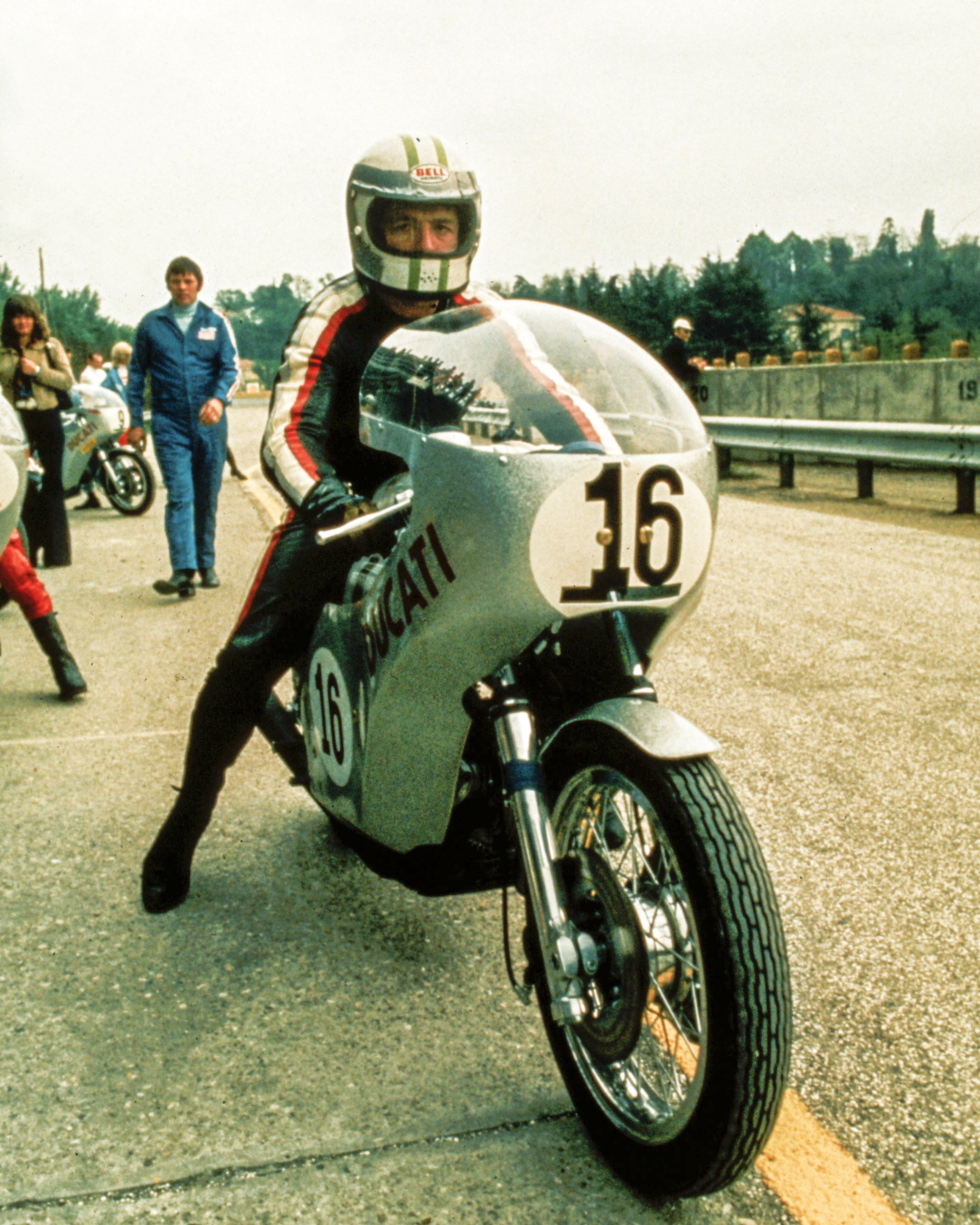
Photo: Unknown author / Wikimedia Commons (Public Domain, Italy 1972)
On 23 April 1972 the British rider Paul Smart, riding a Ducati 750 Imola Desmo prepared specifically for the race, won the inaugural Imola 200. His teammate Bruno Spaggiari finished second on an identical bike. The result mattered out of proportion to a single race victory because Ducati had beaten the much faster Japanese inline-fours from Honda, Kawasaki, and Suzuki, and had done it with a V-twin engine layout that the Japanese had explicitly rejected as obsolete. Smart's Imola win immediately legitimised the 90-degree L-twin as a credible high-performance configuration, established Ducati as a serious factory racing brand outside Italy, and triggered an entire generation of road bikes - the 750 SS, the SuperSport, the 900 SS Mike Hailwood Replica - that were sold on the back of that single result.
Sources: Ducati - Heritage; Wikipedia - 1972 Imola 200.
6. The Monster (1993) - the bike that invented the modern naked segment

Photo: Chris Olszewski (Kgbo) / Wikimedia Commons (CC-BY-SA 4.0)
In 1992 the Argentine-Italian designer Miguel Galluzzi, working in the Ducati design office, proposed a motorcycle built by taking an existing sportbike (the 900 Supersport), removing the fairing, lowering the handlebars, and putting the rider directly on top of the engine. Ducati management approved it reluctantly. The Monster M900 launched in 1993 and immediately created a new product category. The minimalist visual language - exposed trellis frame, exposed V-twin, no fairing, low bars - has been copied by every major manufacturer since. The Monster sold over 350,000 units across its lifetime (every generation through to the current 937), at one point accounted for nearly two-thirds of Ducati's total sales, and is the single product that funded Ducati's expansion through the late 1990s and 2000s.
Sources: Ducati - Monster; Wikipedia - Ducati Monster.
7. The 916 (1994) - arguably the most beautiful motorcycle ever made

Photo: ScuderiaAssindia / Wikimedia Commons (CC-BY-SA 4.0)
In 1994 Ducati launched the 916, designed by Massimo Tamburini at the CRC (Cagiva Research Centre) in San Marino. The 916 is widely regarded as the most beautiful series-production motorcycle ever made, holds a place in the permanent collection of the Guggenheim Museum, and changed sport-bike design language permanently - the under-seat exhausts, the single-sided swing-arm, the narrow nose, the aggressive seating position were all either invented or canonised by this bike. Beyond the styling it was also devastatingly competitive. The 916 (and its evolutions 996 and 998) won four World Superbike rider titles with Carl Fogarty in 1994, 1995, 1998 and 1999, and remained competitive until 2002. For most riders born between 1970 and 1990 the 916 is the motorcycle poster on the wall.
Sources: Ducati - Heritage; Wikipedia - Ducati 916.
8. World Superbike domination

Photo: Gary Watson / Wikimedia Commons (Public Domain)
World Superbike is, in practical terms, Ducati's home championship. Since the series began in 1988 Ducati has won more manufacturers' titles than any other brand and is the only V-twin marque to be consistently competitive against the four-cylinder Japanese factories. The rider list reads like a Ducati hall of fame: Raymond Roche (1990), Doug Polen (1991, 1992), Carl Fogarty (1994, 1995, 1998, 1999), Troy Corser (1996), Troy Bayliss (2001, 2006, 2008), Carlos Checa (2011), Alvaro Bautista (2022, 2023), and Nicolo Bulega (2024 winning Superbike title contender). The brand's combination of road-bike production and WSBK competition has been continuous for more than three decades, longer than any rival, which is a substantial part of why "Ducati" is shorthand for "race-bred road bike" everywhere outside Italy.
Sources: WorldSBK official; Wikipedia - List of WSBK Champions.
9. The Audi / Volkswagen Group acquisition (2012)

Photo: TaurusEmerald / Wikimedia Commons (CC-BY-SA 4.0)
In April 2012 Audi AG purchased Ducati for a reported €860 million, integrating the brand into the Volkswagen Group portfolio that already included Audi, Porsche, Lamborghini, and Bentley. The deal was driven personally by Ferdinand Piech, then chairman of the Volkswagen supervisory board, and was made possible by Ducati's prior owner Investindustrial wanting an exit. Despite repeated press rumours since 2017 that Volkswagen would sell Ducati - the parent group has periodically reviewed its non-core asset list - the brand has stayed put. Under VAG ownership Ducati has hit record annual sales (over 60,000 motorcycles in 2023), expanded the model range, increased R&D investment, and retained an independent engineering culture at Borgo Panigale. The acquisition is now widely cited as one of the more successful automotive-cross-motorcycle integrations on record.
Sources: Audi Group - About; Wikipedia - Ducati (Audi acquisition).
10. The V4 era and MotoGP dominance (2018-present)

Photo: Liauzh / Wikimedia Commons (CC-BY-SA 4.0)
The 2018 Panigale V4 ended forty-seven years of V-twin superbikes at Ducati and brought MotoGP-derived V4 architecture to the road range for the first time. The Streetfighter V4 followed in 2020, the Multistrada V4 in 2021, and the V4 platform is now Ducati's flagship across every premium segment. On the racing side the timing was exact: Francesco Bagnaia, riding the factory Ducati Desmosedici GP, won the 2022 and 2023 MotoGP riders' world championships - Ducati's first since Casey Stoner's 2007 title and the first back-to-back titles in the brand's MotoGP history. Across 2023, Ducati riders won 17 of the 20 race weekends. The MotoGP grid in 2024 carried more Ducatis than any other brand by a wide margin, and the technical transfer from prototype racing to road bike is faster and more direct than at any previous point in the company's century-long history.
Sources: MotoGP - Teams; Wikipedia - Ducati Corse.
A century in, Ducati is still the rare motorcycle company whose name is more recognisable than most of its individual products. The combination of a single regional base (Borgo Panigale, Bologna, since 1935), a continuous engineering identity (Desmodromic valves since 1956, V-twin then V4, Taglioni then his successors), a continuous racing identity (Imola 1972, four decades of WSBK, current MotoGP dominance), and a continuous design identity (Tamburini, Galluzzi, and the people who succeeded them) is hard to replicate. Most legacy motorcycle brands have at least one of those pillars - very few have all four still functioning at the same time.
If you want to see Ducati's range together rather than one bike at a time, the easiest single place is the brand's own museum at Borgo Panigale (open to the public). Otherwise, the lineup in 2026 covers the Panigale V4 / V4 R / V4 S / V4 Senna Speciale superbike line, the Panigale V2 mid-displacement sport, the Streetfighter V4 hyper-naked, the Multistrada V4 / V4 S / V4 Rally adventure tourer, the Monster, the Hypermotard V2 (relaunched at EICMA 2025), and the Scrambler family. A model for almost every riding style, all sharing the Borgo Panigale DNA.
Useful Goutchen links
- Check Ducati models on the Goutchen seat-height simulator - filter the database by brand to see which Ducatis are indexed and how each one feels for your inseam.
- 10 Italian Motorcycle Brands You Should Know - the hub post this Ducati deep-dive sits inside; covers Aprilia, MV Agusta, Moto Guzzi, Bimota, and seven others.
- Bimota: Do You Know This Rare Italian Motorcycle Brand? - the boutique Italian chassis-maker, now part-owned by Kawasaki.