
10 Reasons a Gas-Powered Motorcycle Beats an Electric One
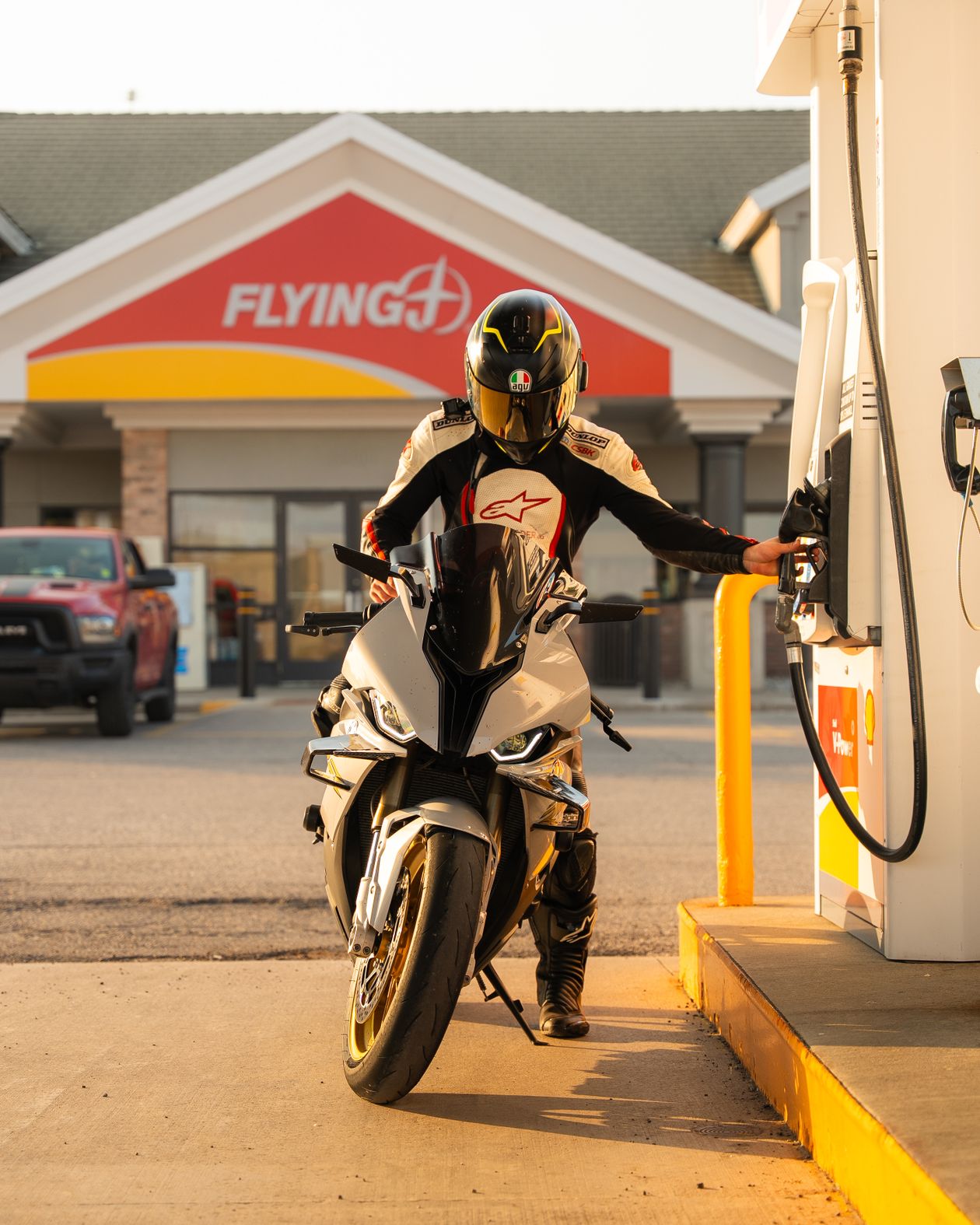
Photo: Bradley de Melo / Pexels
Electric motorcycles get a lot of headline attention in 2026, and for good reason, they have real advantages for the right rider. But for the vast majority of motorcycle ownership scenarios, in most of the world, a gas-powered motorcycle is still the better practical choice. Range, refueling time, purchase price, touring capability, sound, character, service network, cold-weather behaviour, long-term value, and DIY repairability all sit firmly in the internal-combustion camp. Here are 10 reasons gas still wins for most riders, plus an honest acknowledgment at the end that electric is genuinely the right pick for a growing subset of riders.
TL;DR
- Gas bikes still win on the practical fundamentals : 300-500+ km range per tank, 3-minute refueling, 30-50% lower purchase price than equivalent electrics, worldwide service network.
- Character and emotion matter too - the sound, the gear changes, the mechanical feel are why people ride motorcycles in the first place, and electric can’t replicate it.
- Touring, cold weather, long-term value, and DIY repairability are all firmly in gas territory in 2026, and likely will be for at least another 5-10 years.
This piece is the practical counter-argument. The companion post 10 Reasons an Electric Motorcycle Beats a Gas-Powered One argues the other side honestly, and is worth reading alongside this one.
1. Real range per tank : 300-500+ km vs 150-300 km on electric
The single biggest practical advantage of a gas motorcycle is how far it goes between stops. A typical mid-displacement gas bike with a 15-20 L tank covers 300-500 km in real-world riding, and many adventure-tourers with larger tanks (Yamaha Tenere 700 at 16 L, KTM 890 Adventure at 20 L, Honda Africa Twin at 24.8 L) push 400-600 km. By contrast, most electric motorcycles deliver 150-300 km of real-world range per charge, and that figure drops sharply when ridden hard, at sustained highway speeds, or with luggage. The Zero SR/F manufacturer-rated range is 297 km in city mixed ; on the highway at 110-120 km/h, real-world numbers are closer to 130-180 km. That’s not enough to clear a typical day-ride radius.
Source: Cycle World - Electric vs gas long-term riding
2. Refueling in 3 minutes, anywhere
A gas-station stop takes three minutes. You pull in, fill up, pay, and leave. There’s a gas station roughly every 30-50 km in every populated part of the world. By contrast, a DC fast-charge stop on an electric motorcycle takes 30-40 minutes for a 20-80% top-up at the best stations, and a home charge from empty on a wall socket takes 4-10 hours. For commuting that’s manageable ; for any trip longer than a single charge’s range, the time cost compounds fast. Three minutes vs forty minutes, every 200-300 km, is the difference between a 6-hour day and an 8-hour day on a long ride.
Source: RideApart - Long-distance electric motorcycle touring
3. Lower purchase price - typically 30-50% cheaper than an equivalent electric
The price gap is the second-biggest practical advantage. A Kawasaki Z900 lists at roughly €9,500-€10,500 new in Europe ; a comparable-performance Zero SR/F is €21,000-€25,000. A Honda CB650R at €8,500 competes with electrics that start at €15,000+. Even a high-end Ducati Multistrada V4 at €21,500 is cheaper than the equivalent electric ADV (which barely exist). Government incentives close some of the gap, but in most markets and for most riders, gas costs less to buy. The fuel savings recover that gap over 3-5 years on heavy commuting, but if you ride fewer than 8,000 km a year, gas wins on pure economics.
Source: Manufacturer pricing data, EU-listed retail prices 2026
4. Sound, character, and mechanical feel
This is the one electric riders dismiss most often and gas riders care about most. The engine note, the exhaust burble, the rev rise and fall through gears, the mechanical click of a foot-shift, these are not decorations. They’re a core part of why people ride motorcycles instead of cars. A V-twin Harley, a Ducati L-twin, a Triumph triple, a Kawasaki four-cylinder, a BMW boxer - each has a sonic and tactile signature that defines the brand. Electric motorcycles can be smooth and fast, but they’re sonically and mechanically generic by comparison. Riding a motorcycle is partly an emotional experience, and gas still owns the emotion.
Source: Bennetts BikeSocial - The case for keeping internal combustion
5. Service network and parts availability everywhere
You can break down on a gas motorcycle in rural Morocco, rural Montana, central Mongolia, the Anatolian highlands, or the back roads of Patagonia, and find a mechanic who can fix it. Honda, Yamaha, Kawasaki, Suzuki, Triumph, BMW, KTM, Harley parts and service are available in every country with paved roads. By contrast, electric motorcycle parts are concentrated in major urban centres of major markets, dealer networks are thin, and a battery or controller fault on a Zero in rural Spain often means the bike sits for weeks waiting on a flown-in part. The global ICE service network is a hundred years deep. Electric is starting.
Source: Motorcyclist - Global service network analysis
6. Long-term value retention and battery degradation
A well-maintained gas motorcycle holds value for 30-50 years. Vintage bikes from the 1970s still command good money. By contrast, lithium-ion batteries degrade with age and cycle count : most electric motorcycle batteries retain only 70-80% of original capacity after 8-10 years of typical use. Battery replacement costs €3,000-€8,000 depending on the bike, often more than half the used market value. That structurally caps how long an electric motorcycle stays usefully on the road, and it punishes the second and third owners hardest. The used-electric market is still figuring out how to price degraded batteries ; the used-gas market knows exactly what it’s doing.
Source: International Energy Agency - Battery degradation in EVs
7. Real touring capability
Touring is still firmly gas territory. The infrastructure required for long-distance electric touring (fast-charge stations every 100-150 km along motorways, redundancy in case one is broken, charging compatibility across brands, a place to charge overnight at small-town hotels) doesn’t yet exist outside a handful of corridors in Western Europe and the US west coast. Cross-Europe, cross-Africa, trans-American, or central Asian touring on a current electric motorcycle is a project ; on a gas tourer (BMW R 1300 GS, Yamaha Tenere 700, Honda Africa Twin, Harley Pan America), it’s a long weekend you don’t think twice about.
Source: Adventure Motorcycling Handbook - Long-distance touring infrastructure
8. Model variety and choice
The 2026 gas motorcycle market offers thousands of models across dozens of brands, in every category and every price point : cruisers (Harley, Indian, Honda Rebel), sport (Ducati Panigale, Yamaha R1, Kawasaki ZX-10R), naked (Triumph Speed Triple, KTM 1390 Super Duke, BMW S 1000 R), ADV (BMW GS, Honda Africa Twin, KTM 890 Adventure, Yamaha Tenere 700), retro (Royal Enfield, Triumph Bonneville), scrambler (Ducati Scrambler, Triumph Scrambler 900), tourer (Honda Gold Wing, BMW K 1600). The entire global electric motorcycle market totals roughly 40-50 production models. If you want a specific bike for a specific job, gas almost certainly has it.
Source: Motorcyclist - Global model catalogue 2026
9. Cold-weather performance
Lithium-ion batteries lose 20-40% of usable capacity below 0°C, and charging slows down dramatically in cold conditions. Range that’s already shorter than gas drops further when you need it most, in winter commuting. Gas engines are essentially unaffected by ambient temperature : a cold start takes a few extra seconds, fuel mileage drops slightly, but the practical riding range is identical at -10°C and +30°C. For riders in northern Europe, Canada, the upper US, or any climate with real winter, the cold-weather range hit on an electric is a serious operational consideration. On a gas bike, it isn’t.
Source: Battery University - Lithium-ion temperature performance
10. DIY repairability and the aftermarket
Gas motorcycles are designed to be worked on. The aftermarket is mature : exhausts (Akrapovic, Yoshimura, SC-Project), suspension (Öhlins, K-Tech, Wilbers), ergonomic parts (bar risers, seat upgrades, peg lowering kits), ECU flashes, performance air filters, custom seats, paint and bodywork. Owners who want to wrench in their garage can rebuild engines, change valve clearances, fit cams, replace clutches, and YouTube has tutorials for every step. Electric motorcycles, by contrast, are largely sealed, software-locked appliances. The battery pack is non-serviceable, the motor controller is proprietary, the firmware is dealer-only. If you like working on your own bike, the electric scene is genuinely worse.
Source: RevZilla - DIY motorcycle maintenance ecosystem
So is gas the right choice for every rider?
No. Electric motorcycles have real advantages, and for a specific kind of rider in 2026, electric is genuinely the better practical choice.
If you commute under 100 km a day, have a charger at home, ride mostly in a city with low-emission zones (London ULEZ, Paris ZFE), and value the instant torque and silence more than the engine note, electric already wins. Running costs are roughly one-third to one-fifth of gas, maintenance is minimal, urban access is improving, and incentives close the upfront price gap. The companion piece 10 Reasons an Electric Motorcycle Beats a Gas-Powered One lays the electric case out in detail, and it’s worth reading alongside this one.
The honest takeaway : for everyday riding in most of the world in 2026, gas still makes more sense for most riders. But the gap is closing on every model cycle, and the right rider profile for electric (city-based, home-charging, commuter) is growing fast. In ten years this list might read very differently. In 2026, gas wins on practical fundamentals, character, infrastructure, and choice.
Useful Goutchen link:
- Companion read: 10 Reasons an Electric Motorcycle Beats a Gas-Powered One - the case from the other side