
Moto Guzzi: 10 Things to Know About Europe's Oldest Motorcycle Brand

Photo: Kaitu / Wikimedia Commons (CC-BY-SA 4.0)
Moto Guzzi is the oldest European motorcycle brand still in continuous production. Founded on 15 March 1921 in the small Lombardy town of Mandello del Lario on the eastern shore of Lake Como, the company has built every one of its motorcycles in the same factory for more than a century. The signature is engineering rather than style: the spread eagle logo (a tribute to founding partner Giovanni Ravelli), the transverse 90-degree V-twin engine architecture in continuous use since 1967, and the legendary Otto Cilindri V8 racer of the 1950s are the through-lines that connect a 1921 startup to a 2026 product range.
This is the deep-dive companion to the "10 Italian Motorcycle Brands You Should Know" hub. If Ducati is the brand that defines what an Italian sport bike looks like, and Aprilia is the brand that defines how one races, Moto Guzzi is the brand that defines what Italian motorcycle heritage looks like - 105 years of unbroken production from one factory, with most of the original engineering culture still intact.
TL;DR
- Founded 15 March 1921 in Mandello del Lario on Lake Como, still operating from the same factory more than a century later - the oldest European motorcycle brand in continuous production.
- Defined by the transverse 90-degree V-twin engine (in continuous use since 1967), the spread eagle logo (tribute to founding partner Giovanni Ravelli), and the legendary Otto Cilindri V8 racer of the 1950s.
- Part of Piaggio Group since 2004, with the centennial V100 Mandello (the first liquid-cooled Guzzi, first with active aerodynamics) as the current flagship.
1. Founded 15 March 1921 in Mandello del Lario
Moto Guzzi was founded on 15 March 1921 as "Societa Anonima Moto Guzzi" by three Italian Air Force veterans from World War I: Carlo Guzzi (the engineer who designed the first motorcycles), Giorgio Parodi (the financier and aviation pilot whose family money capitalised the company), and the memory of Giovanni Ravelli - a fellow pilot who had agreed to handle the racing side but who died in a flying accident in August 1919 before production began. The spread-eagle in the Moto Guzzi logo is a direct tribute to Ravelli; it was the insignia of the air-force unit all three men served in. The location was Carlo Guzzi's home town of Mandello del Lario on the east shore of Lake Como, and the company has manufactured every motorcycle that wears the Guzzi name from that same location since.
Sources: Moto Guzzi - World; Wikipedia - Moto Guzzi.
2. The Normale (1921) - Moto Guzzi's first motorcycle

Photo: Midnight_bird, retouched by Auge=mit / Wikimedia Commons (CC-BY-SA 3.0)
The first production Moto Guzzi was the Normale, a 500cc horizontal-single. The defining feature of the engine - the cylinder mounted flat with the head pointing forward into the airstream - was unusual for the era and became the visual identity of every Moto Guzzi single-cylinder right up to the 1976 Nuovo Falcone. The flat-single layout had real engineering advantages: it dropped the centre of gravity, kept the centre of mass low and forward in the chassis, and put the cylinder head directly in clean air for cooling. The Normale was a credible motorcycle in 1921 and an excellent one by 1924. By the end of the 1920s Moto Guzzi was building several thousand bikes a year from the Mandello factory, exporting across Europe, and funding the racing programme that would define the brand's next two decades.
Sources: Moto Guzzi - World; Wikipedia - Moto Guzzi Normale.
3. Pre-war and post-war racing dominance
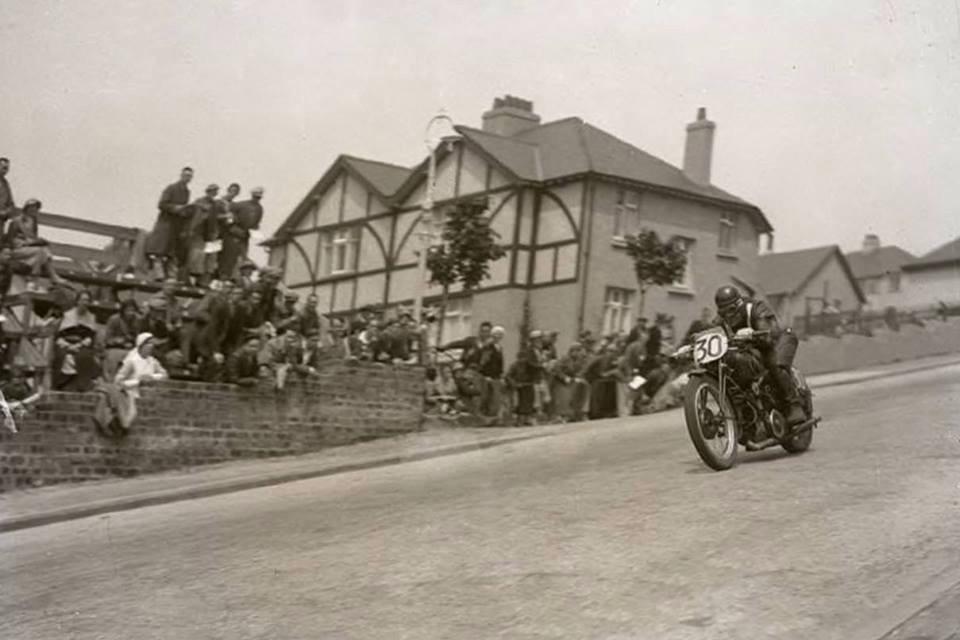
Photo: Unknown author / Wikimedia Commons (Public Domain, UK pre-1956)
Moto Guzzi went racing seriously almost immediately. The first works championship came in 1924 at the Lario Circuit. The defining international victory came in 1935 at the Isle of Man TT Lightweight class, where the Irish rider Stanley Woods won on a 250cc Moto Guzzi - the first non-British manufacturer to win at the TT in twenty-four years. After the war the works racing department, led by chief engineer Giulio Cesare Carcano, dominated the 250cc and 350cc world championships across the 1950s with riders including Bruno Ruffo, Enrico Lorenzetti, and Fergus Anderson. By the end of the 1950s Moto Guzzi had won fourteen Isle of Man TT victories and eight world championships - a record disproportionate to the company's size.
Sources: Moto Guzzi - History; Wikipedia - Moto Guzzi (Racing).
4. The first motorcycle wind tunnel in the world (1950)

Photo: Unknown author / Wikimedia Commons (Public Domain, Italy ca. 1950s). Original via motoguzzi.com Storia.
In 1950 Moto Guzzi did something no other motorcycle factory had ever done: they built a full-scale wind tunnel inside the Mandello del Lario factory. The tunnel was specifically dimensioned for motorcycles - a man-sized cross-section, a 60 m/sec airflow, instrumentation racks designed for two-wheeled testing. No other motorcycle manufacturer built one until decades later, and the Moto Guzzi facility is still there, still operational, still the only purpose-built motorcycle wind tunnel in the industry. The tunnel was used to develop the V8 racer, the Otto Cilindri's fairing geometry, the dustbin fairings of the 1950s 350cc bikes, and many subsequent production models. For a 1950 small-volume manufacturer to make this kind of capital investment in aerodynamic R&D - decades before the rest of the industry took it seriously - is a clean example of why Moto Guzzi's racing record was disproportionate to its size.
Sources: Moto Guzzi - World; Wikipedia - Moto Guzzi.
5. The Otto Cilindri V8 racer (1955-1957)

Photo: Giuliano Marchetti / Wikimedia Commons (CC-BY 4.0)
Designed by Giulio Cesare Carcano between 1953 and 1955, the Moto Guzzi Otto Cilindri is one of the most extraordinary motorcycles ever built: a 500cc, 90-degree, water-cooled V8 with double overhead camshafts, eight Dell'Orto carburettors, and a maximum power output of around 78 hp - in a chassis weighing roughly 152 kg. Top speed was reported at 281 km/h, which in 1957 made it the fastest motorcycle in the world. The bike won the Belgian Grand Prix in 1957 with Dickie Dale and was being developed for an outright assault on the 500cc world championship when the FIM tightened the regulations and the Moto Guzzi board, alongside Gilera and Mondial, withdrew from world-championship racing at the end of 1957. The Otto Cilindri never raced again. Both surviving examples are in the Moto Guzzi museum at Mandello del Lario.
Sources: Moto Guzzi - Museum; Wikipedia - Moto Guzzi V8.
6. The transverse 90-degree V-twin (1967)

Photo: grouchomax (derivative work by Ligabo) / Wikimedia Commons (CC-BY 2.0)
By the mid-1960s Moto Guzzi needed a new platform and a new engine. The engine arrived from an unexpected source: Carcano had designed a 90-degree V-twin for an Italian government 3x3 military and civilian utility vehicle (the FIAT 3x3 was the original target), and the project had stalled. Carcano and his team adapted that engine for two wheels by mounting it transversely, with the crankshaft running fore-and-aft and the cylinder heads sticking out into the airstream on either side of the rider's legs. The result first reached production in the 1967 V7 700, a touring bike adopted almost immediately as the official motorcycle of the Italian state police. The architecture has remained Moto Guzzi's signature ever since - more than 58 years of continuous production with the same fundamental engine layout, longer than any other engine configuration on any other brand still building motorcycles.
Sources: Moto Guzzi - History; Wikipedia - Moto Guzzi V7.
7. The V7 Sport and the Tonti frame (1971)

Photo: Moto-gundy / Wikimedia Commons (CC-BY-SA 3.0)
In 1971 the chassis engineer Lino Tonti designed a new tubular-steel frame that wrapped tightly around the transverse V-twin, narrowed the engine itself (Tonti removed the dynamo housing to lower the crankcase), and produced the V7 Sport - the first genuine Moto Guzzi sport motorcycle. The "Tonti frame" became one of the most respected motorcycle chassis ever made, prized for stability at the high speeds the V-twin could now reach and for the way it disguised the engine's mass once the bike was leaned over. Variations of the Tonti frame stayed in production for more than thirty years and were used under most of Moto Guzzi's classic sport bikes through the 1970s, 80s, and into the 1990s. The original 1971 V7 Sport, in its "Telaio Rosso" (red-frame) launch livery, is now a collector item that trades in the high five figures.
Sources: Moto Guzzi - World; Wikipedia - V7 Sport.
8. The Le Mans (1976) - Moto Guzzi's cafe-racer answer

Photo: SG2012 (Steve Glover) / Wikimedia Commons (CC-BY 2.0)
The 850 Le Mans Mk1, launched in 1976, was Moto Guzzi's interpretation of the cafe-racer format that was then sweeping European motorcycling. Built on the Tonti frame, with a tuned 844cc V-twin producing 71 hp, clip-on bars, a small bikini fairing, and quad disc brakes, the Le Mans was one of the best-handling Italian sport bikes of the late 1970s. It also gave Moto Guzzi a credible weapon against the new generation of Japanese in-line fours that had arrived after the Honda CB750. The Le Mans nameplate ran through five generations (Mk1 1976, Mk2 1978, Mk3 1981, Mk4 1985, Mk5 1988) until 1993, when it was finally retired. Pre-1981 Le Mans Mk1 examples in original condition are now blue-chip vintage Italian motorcycles.
Sources: Moto Guzzi - World; Wikipedia - Moto Guzzi Le Mans.
9. The De Tomaso era, then Aprilia and Piaggio (1973-2004)

Photo: SG2012 (Steve Glover) / Wikimedia Commons (CC-BY 2.0). 1981 Le Mans Mk2 - a product of the De Tomaso ownership period.
In 1973 the Argentine-Italian industrialist Alejandro De Tomaso acquired Moto Guzzi as part of his SEIMM industrial group, which also owned Benelli at the time. The De Tomaso era ran for nearly thirty years and is a complicated legacy: some great bikes (the Le Mans Mk2, the California II, the 1100 Sport, the V11 Le Mans of 1999) but consistent under-investment in modernising the Mandello factory and the engineering culture. By the late 1990s Moto Guzzi was technologically behind its rivals. In 2000 Aprilia under Ivano Beggio bought Moto Guzzi, then in 2004 Piaggio Group acquired both Aprilia and Moto Guzzi. The Piaggio era began the first major capital investment in the Mandello facility in three decades - the new assembly line, the engineering office expansion, and the funding for the V100 platform programme.
Sources: Piaggio Group - About; Wikipedia - Moto Guzzi (Ownership).
10. The V100 Mandello (2022) and the modern Moto Guzzi

Photo: Franken-Guzzista / Wikimedia Commons (CC-BY-SA 4.0)
To mark the brand's 100th anniversary (slightly delayed by COVID), Moto Guzzi launched the V100 Mandello in 2022. The bike was a series of firsts for the brand: the first liquid-cooled Moto Guzzi production motorcycle in more than a century, the first production motorcycle anywhere with active aerodynamics (electrically deployed side wings on the fairing that open at speed and close at low speed), and the first Moto Guzzi designed around a thoroughly modern electronic architecture - ride modes, cornering ABS, traction control, cruise control. The 2024 Stelvio extended the V100 platform into the adventure-touring segment. The classic V7, V9 Bobber, V85 TT, and California lines continue alongside the V100 family. The Mandello del Lario factory tour and museum remain a pilgrimage destination for motorcyclists, with the open weekend held every September attracting tens of thousands of riders.
Sources: Moto Guzzi - V100 Mandello; Wikipedia - V100 Mandello.
A hundred and five years in, Moto Guzzi is the rare motorcycle brand whose continuity is the story. The factory has stood on the same patch of ground at Mandello del Lario since 1921. The transverse V-twin has been the engine since 1967. The spread eagle has been the logo since the beginning. The museum at the factory still holds the prototype V8, the wind tunnel still works, and the engineering office is still a few hundred metres from the lake. Other Italian brands have stronger racing records (Aprilia, MV Agusta) or higher production volumes (Ducati), but no European motorcycle manufacturer has assembled bikes in the same building for as long.
The 2026 lineup carries the brand identity forward across categories: the classic V7 (Stone, Special, and Cafe trims), the V9 Bobber and V9 Roamer cruisers, the V85 TT and V85 Strada middleweight adventure bikes, the new V100 Mandello sport-tourer and Stelvio adventure twins, the California 1400 cruiser, and the niche MGX-21 bagger. Every one of them shares the transverse V-twin signature and the Mandello del Lario assembly line.
Useful Goutchen links
- Bimota: Do You Know This Rare Italian Motorcycle Brand? - another Italian heritage-brand deep-dive.