
Aprilia: 10 Things to Know About Italy's Racing Brand

Photo: Calreyn88 / Wikimedia Commons (CC0)
Aprilia is the Italian motorcycle brand whose identity is built almost entirely around racing. Founded in 1945 in Noale, a small town in the Veneto region north of Venice, the company started as a bicycle workshop, pivoted to motorcycles in the late 1960s under Ivano Beggio, and spent the next four decades winning Grand Prix championships at a rate that no other Italian manufacturer except MV Agusta has ever matched. Today Aprilia holds 54 World Championship titles across the Grand Prix classes, the second-highest tally for any single brand in motorcycle racing history after Honda.
This is the deep-dive companion to the "10 Italian Motorcycle Brands You Should Know" hub. If Ducati is the brand that defines what an Italian motorcycle looks like to the rest of the world, Aprilia is the brand that defines what one races like. The ten moments below trace how a small Veneto bicycle firm became one of the most race-pedigreed motorcycle factories on the planet.
TL;DR
- Founded 1945 in Noale (Veneto) as a bicycle company, Aprilia pivoted to motorcycles under Ivano Beggio in 1968 and built its identity around Grand Prix racing.
- Italy's racing brand: 54 World Championship titles across Grand Prix classes, Max Biaggi's four consecutive 250cc titles, and two World Superbike titles with the V4-powered RSV4.
- Now part of Piaggio Group since 2004, racing in MotoGP since 2015 with the RS-GP, and producing the RSV4 flagship plus the RS 660 / Tuono 660 / Tuareg 660 parallel-twin range.
1. Founded in 1945 in Noale (Veneto)

Logo: APRILIA RACING S.R.L. / Piaggio & C. S.p.A. via Wikimedia Commons (public domain text-logo; trademark of Aprilia)
Aprilia was founded in 1945 by Cavaliere Alberto Beggio in the small Veneto town of Noale, about 25 kilometres inland from Venice. The original business was bicycles, not motorcycles. Postwar Italy needed cheap personal transport and Noale was an industrial area with the right supplier network. The Beggio family ran the workshop for more than twenty years on bicycles alone, with one key advantage over similar regional manufacturers - Alberto invested early in machinery, frames, and dealer distribution, which let the company scale faster than the average bicycle workshop and survive the period when most small Italian competitors disappeared.
Sources: Aprilia - World; Wikipedia - Aprilia.
2. Ivano Beggio takes over and pivots to motorcycles (1968)
In 1968 Alberto's son Ivano Beggio took the reins at the age of 24 and made the single most consequential decision in the company's history: he pivoted Aprilia from bicycles into motorcycles. The first Aprilia motorcycles were small-displacement two-strokes aimed at the off-road and youth market - sectors that the Italian giants of the time (Ducati, Moto Guzzi, MV Agusta) had largely ignored. Within a decade the factory was producing 50cc and 125cc sport bikes for the local market, then expanding to mid-displacement enduros. Ivano remained the driving force behind Aprilia's identity, racing programme, and product strategy until the mid-2000s, and is the figure most directly responsible for what the brand became.
Sources: Aprilia - World; Wikipedia - Aprilia.
3. First Grand Prix victory (1985-1987)

Photo: Rikita / Wikimedia Commons (CC-BY-SA 3.0)
Aprilia began Grand Prix racing seriously in the early 1980s with a 250cc programme, and the first Grand Prix victory came on 30 August 1987 at the San Marino 250cc GP at Misano with Italian rider Loris Reggiani. The result mattered less for the single victory than for what it signalled. A small Veneto factory had built a competitive Grand Prix racing motorcycle and beaten the Japanese works teams at the highest level of two-stroke competition. From that point Ivano Beggio committed Aprilia to a long-term racing strategy across the small Grand Prix classes - 125cc and 250cc - that would define the brand for the next twenty years and form the technical and commercial foundation for everything that followed.
Sources: Aprilia Racing; Wikipedia - Loris Reggiani.
4. First World Championship - Alessandro Gramigni (1992)

Photo: Wayne Baker / Wikimedia Commons (CC-BY 2.0)
Aprilia's first World Championship title in any class came in 1992 with Italian rider Alessandro Gramigni winning the 125cc Grand Prix world championship. The 125cc class was the volume entry point for European riders and the most price-sensitive racing category, which suited Aprilia's small-volume engineering: the company could iterate quickly on the chassis and engine, undercut the cost structure of the Honda and Yamaha works teams, and still beat them on outright performance. Gramigni's title was followed almost immediately by deeper Aprilia investment in 250cc, where the technical regulations and the rider pool gave Italian factories a more equal footing against the Japanese.
Sources: MotoGP - Alessandro Gramigni; Wikipedia - Alessandro Gramigni.
5. Max Biaggi and 250cc dominance (1994-1997)

Photo: motoracereports / Wikimedia Commons (CC-BY 3.0). Biaggi during his 2010 WSBK Aprilia title campaign.
Between 1994 and 1996 the Rome-born rider Max Biaggi won three consecutive 250cc World Championships for Aprilia, with a fourth title in 1997 added on Honda machinery before he switched to 500cc. Biaggi remains the rider most associated with the Aprilia brand outside Italy, and the 250cc V-twin Aprilias of the mid-1990s, in Chesterfield green-and-white livery, are the bikes that built the road-product narrative the rest of the decade. The story did not end with the 250cc class. In 2010 Biaggi returned to Aprilia for the new World Superbike programme on the V4-engined RSV4 and won the 2010 WSBK world title, then took a second WSBK championship for the brand in 2012 - cementing his name with Aprilia across two distinct eras of the sport.
Sources: Aprilia Racing; Wikipedia - Max Biaggi.
6. The RS250 (1995) - the legendary two-stroke V-twin

Photo: Shohei ninomiya / Wikimedia Commons (CC-BY-SA 3.0)
Aprilia's racing pedigree translated to a road product with the RS250, launched in 1995. A two-stroke 90-degree V-twin sportbike built around an engine licensed from Suzuki (the RGV250 platform) but reworked into a complete chassis and bodywork package that owed everything to the Aprilia 250cc Grand Prix programme. The RS250 sold in three iconic liveries: the Chesterfield green-white sponsor scheme, the Reggiani championship replica, and the Max Biaggi replica. Production ran until 2003 - shortly before the global two-stroke road-bike segment was killed by Euro 2 emissions regulations - and used examples are now collector items. For many riders born between 1975 and 1990, the RS250 is the single bike that crystallises why people fall in love with Italian sport motorcycles.
Sources: Aprilia - World; Wikipedia - Aprilia RS250.
7. The RSV Mille (1998) - Aprilia's first litre-class superbike

Photo: Calreyn88 / Wikimedia Commons (CC0)
The RSV Mille, launched in 1998, was Aprilia's first attempt at a litre-class production superbike. The engine was a 60-degree V-twin built by Rotax in Austria to Aprilia's specification (Rotax was already a long-term Aprilia engine partner from the small-displacement programmes). The chassis, the suspension, the bodywork, and the brake calibration were Aprilia's own work. The result was a bike that beat the Japanese inline-four superbikes on handling and aesthetics, even when it could not match them on outright peak power, and it established Aprilia in a segment that had previously been a Japanese duopoly. Production ran in evolving form (RSV Mille, RSV 1000, RSV 1000 R, RSV 1000 R Factory) until the RSV4 replaced it in 2009.
Sources: Aprilia - World; Wikipedia - Aprilia RSV Mille.
8. Acquired by Piaggio Group (2004)
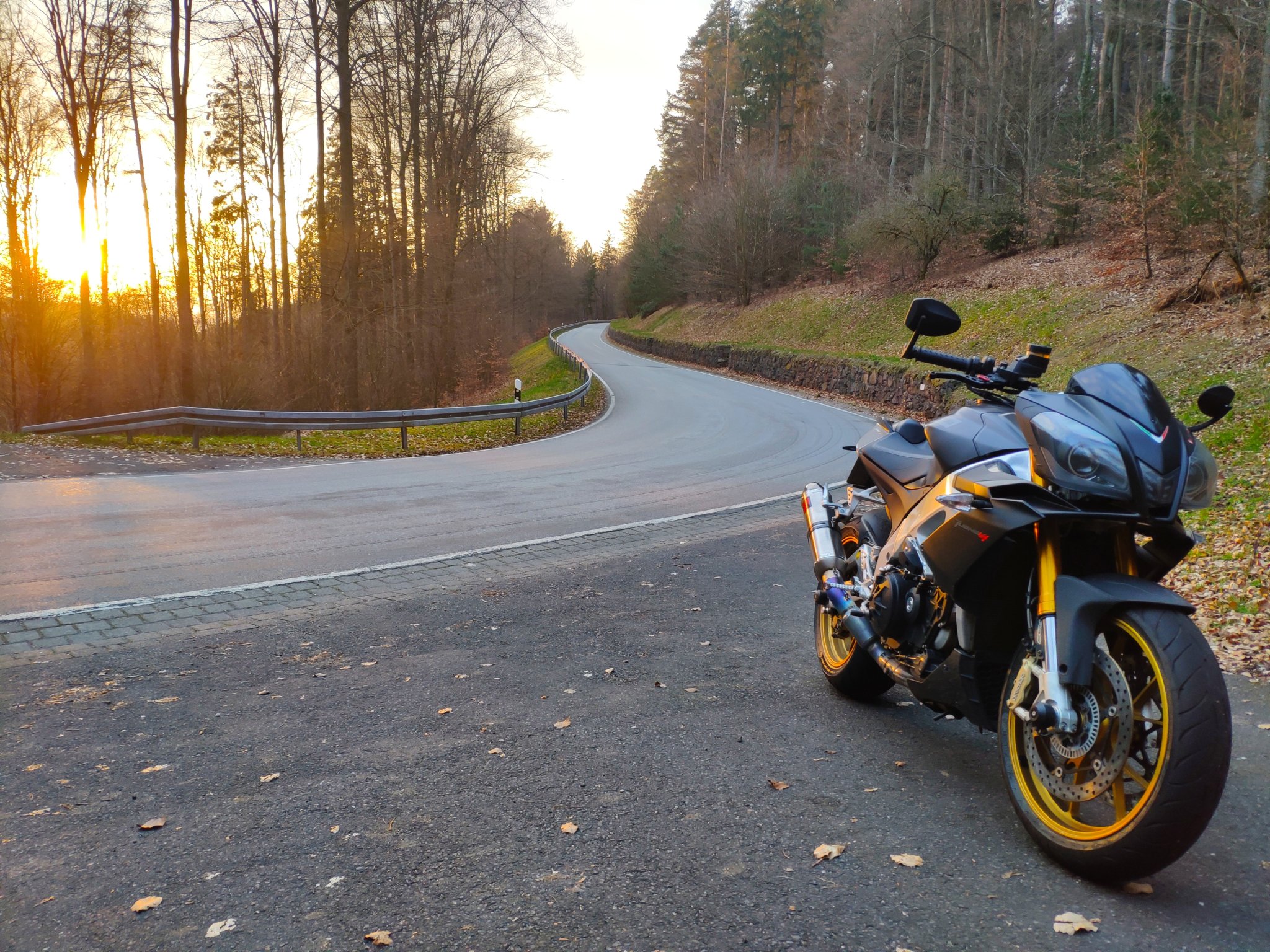
Photo: DesmoV4 / Wikimedia Commons (CC-BY-SA 4.0). Tuono V4 R 2014 - the V4 platform extended to the naked-bike range under Piaggio ownership.
By the early 2000s Aprilia's expansion through racing and the litre-class superbike segment had outrun its balance sheet. The company had also acquired Moto Guzzi in 2000, doubling its complexity without doubling its scale. Financial pressure peaked in 2003-2004, and in December 2004 Piaggio Group acquired Aprilia in a debt-and-shares transaction valued at roughly €100 million. The acquisition placed Aprilia, Moto Guzzi, Vespa, Gilera, and Derbi inside the same parent group - the largest motorcycle manufacturer in Europe by volume. For Aprilia the deal stabilised the finances, kept the Noale factory and headquarters intact, and allowed the racing programme to continue under Romano Albesiano and a long-term technical management team that is still in place today.
Sources: Piaggio Group - About; Wikipedia - Aprilia (Piaggio acquisition).
9. The RSV4 era (2009-present)

Photo: Tony Hisgett / Wikimedia Commons (CC-BY 2.0)
In 2009 Aprilia replaced the V-twin RSV with the RSV4 - the first production motorcycle to use a 65-degree V4 engine derived directly from prototype MotoGP architecture. The RSV4 has been Aprilia's flagship ever since and has carried the brand's competitive narrative through three WSBK rider titles (Max Biaggi 2010 and 2012, Sylvain Guintoli 2014) and seven WSBK manufacturers' championships. The platform has been extended to the Tuono V4 hyper-naked, which uses the same engine with shorter gearing and an aluminium handlebar in place of clip-ons. In 2020 Aprilia added the RS 660 / Tuono 660 / Tuareg 660 parallel-twin range, miniaturising the V4 product philosophy for a more accessible price point and bringing Aprilia into segments where Japanese mid-displacement bikes had previously dominated.
Sources: Aprilia - RSV4; Wikipedia - Aprilia RSV4.
10. MotoGP return (2015-present)

Photo: Liauzh / Wikimedia Commons (CC-BY-SA 4.0)
Aprilia returned to the premier class of motorcycle racing in 2015 with the RS-GP prototype, after a decade away from the top-tier programme. The early years were a development slog. The breakthrough came across the 2022-2023 seasons with Aleix Espargaro claiming Aprilia's first MotoGP race wins since the brand's 1970s 250cc era, and the bike's competitiveness has continued under Maverick Vinales, Marco Bezzecchi, and the 2025 signing of 2024 MotoGP champion Jorge Martin. Across all classes, Aprilia ranks second only to Honda in total Grand Prix victories - a position the brand has held for more than a decade. The RS-GP is the only Italian motorcycle apart from the Ducati Desmosedici GP currently fighting at the front of the premier-class grid.
Sources: Aprilia Racing - MotoGP; Wikipedia - Aprilia RS-GP.
Eighty years in, Aprilia is the rare motorcycle manufacturer whose identity is almost entirely a story of racing. Other Italian brands have racing pedigree (Ducati's WSBK record, MV Agusta's 75 World Championships) but build their public-facing narrative around design or heritage or sound. Aprilia's narrative is the trophy cabinet: 54 World Championship titles, second-most of any manufacturer ever, with the bulk of those wins concentrated in the small Grand Prix classes that the rest of the industry has largely abandoned. The current MotoGP programme is the first sustained attempt to translate that small-class dominance into premier-class results, and the trajectory of the last three seasons suggests the project will keep paying off.
The 2026 lineup covers the RSV4 superbike (in standard and Factory trim, plus the RSV4 X track-only special), the Tuono V4 hyper-naked, the parallel-twin RS 660 sport and Tuono 660 naked, the Tuareg 660 adventure, the Shiver and Dorsoduro mid-range V-twin singles (still in some markets), and the SR scooter family. A range built around racing, with the same Noale design office that has run the programme since the 1980s.
Useful Goutchen links
- Check Aprilia models on the Goutchen seat-height simulator - filter the database by brand to see which Aprilias are indexed and how each one fits your inseam.
- Bimota: Do You Know This Rare Italian Motorcycle Brand? - another Italian boutique brand deep-dive in the same series.