
Buying a used motorcycle is exciting, but a 15-minute walkaround can save you thousands. This is the complete 16-point inspection the goutchen.com team uses before paying for any used bike: what to look at, what to listen for, and exactly when to walk away.
Two free downloads to take this with you:
This checklist covers the technical inspection of a used motorcycle. The legal and paperwork side is covered in a separate goutchen.com article. Until then, check with a trusted professional or your local authority before you buy.
How to use this checklist
- The Guide: the 16 inspection points explained, with what to check and what should make you walk away. Read this at home, before you go.
- The Mileage Scale: a quick reference for judging whether a bike's mileage is low, normal or high.
- The Printable Scorecard: print it and take it with you. Score each bike out of 10 on every point, add up the total, and compare up to three bikes side by side.
A flashlight · a tire tread depth gauge · gloves · a clean rag · a knowledgeable friend · and the printed scorecard, with a pen.
Before you meet the seller: safety first
- ⚠️ Beware of scams. If a deal sounds too good to be true, it usually is.
- 👬 Never go alone. Bring a friend, ideally someone who knows motorcycles.
- 👀 Meet in public. Choose busy, well-lit places like a parking lot or gas station.
- 💬 Tell someone your plan. Share the meeting place and time with family or a friend.
- 💸 Don't carry large amounts of cash. Bring only what you need once the deal is confirmed.
- 📞 Keep your phone charged and within reach, in case you need help.
- 🧾 Ask for maintenance records and receipts. They show how well the bike was cared for.
- 🧠 Take your time. Don't let the seller rush you. Inspect everything and trust your instincts.
- 🏍️ Only test-ride if it's safe. Wear proper gear and make sure the seller agrees first.
- 📷 Document the visit. Photograph the bike and its papers for your own records.
The Mileage Scale
On a used bike you read one number, the total mileage shown on the odometer. Find that number in the table below. The middle column is your ready-made score out of 10 for point 1 (Mileage) on the scorecard.
| Total mileage on the odometer | Score | What it usually means |
|---|---|---|
| Under 5,000 mi Under 8,000 km | 10 | Almost new, barely run in. |
| 5,000 – 15,000 mi 8,000 – 24,000 km | 9 | Very low mileage. |
| 15,000 – 25,000 mi 24,000 – 40,000 km | 8 | Low mileage, plenty of life left. |
| 25,000 – 35,000 mi 40,000 – 56,000 km | 7 | Average for a used bike. |
| 35,000 – 45,000 mi 56,000 – 72,000 km | 6 | Above average, fine if it has been well serviced. |
| 45,000 – 55,000 mi 72,000 – 88,000 km | 5 | Higher mileage, check the service history closely. |
| 55,000 – 70,000 mi 88,000 – 112,000 km | 4 | High mileage, expect some worn parts. |
| 70,000 – 90,000 mi 112,000 – 145,000 km | 3 | Very high mileage. |
| 90,000 – 110,000 mi 145,000 – 177,000 km | 2 | Extremely high, major work likely due soon. |
| Over 110,000 mi Over 177,000 km | 1 | Worn out for most bikes, buy only as a cheap project. |
Give it 0 if the odometer is broken, unreadable, or looks tampered with. You simply can't trust the number.
The table fits an average mid-size motorcycle. Small bikes and sportbikes work harder, so drop the score by 1 to 2 points. Large touring bikes and cruisers last longer, so add 1 to 2. A well-kept big cruiser at 80,000 mi can easily be a 6, not a 3.
Regular, gentle use keeps seals, fuel and the battery healthy. A bike that barely moved for years can need more work than one ridden often and serviced well. And if a low reading doesn't match worn grips, pegs and seat, suspect a wound-back odometer.
The 16-Point Inspection
Work around the bike in order. For each point, read what to check, then give the bike a score out of 10 on your printed scorecard.
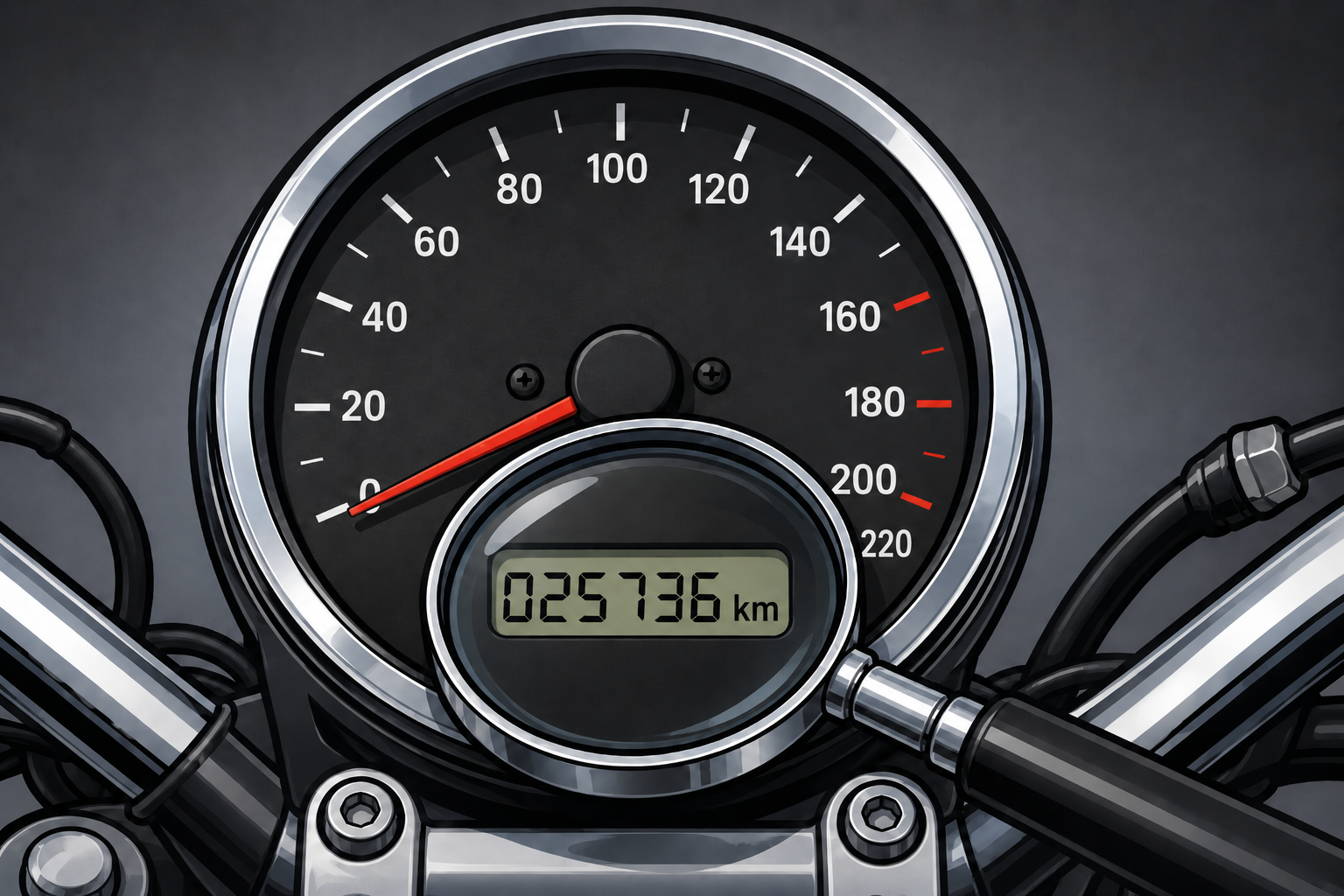
1Mileage (Odometer Reading)
Why it matters. The odometer is your first clue to how hard the bike has worked, but it only tells the truth when it matches the bike's age, condition and service history.
What to check
- Read the total mileage on the odometer and find its 0 to 10 score on the Mileage Scale above.
- Watch for tampering: worn grips, pegs, seat or controls on a "low-mileage" bike are a red flag.
- Cross-check the number against service receipts and old inspection records.
🚩 Walk away if: the odometer looks tampered with, or the mileage cannot be explained by the bike's condition and history.
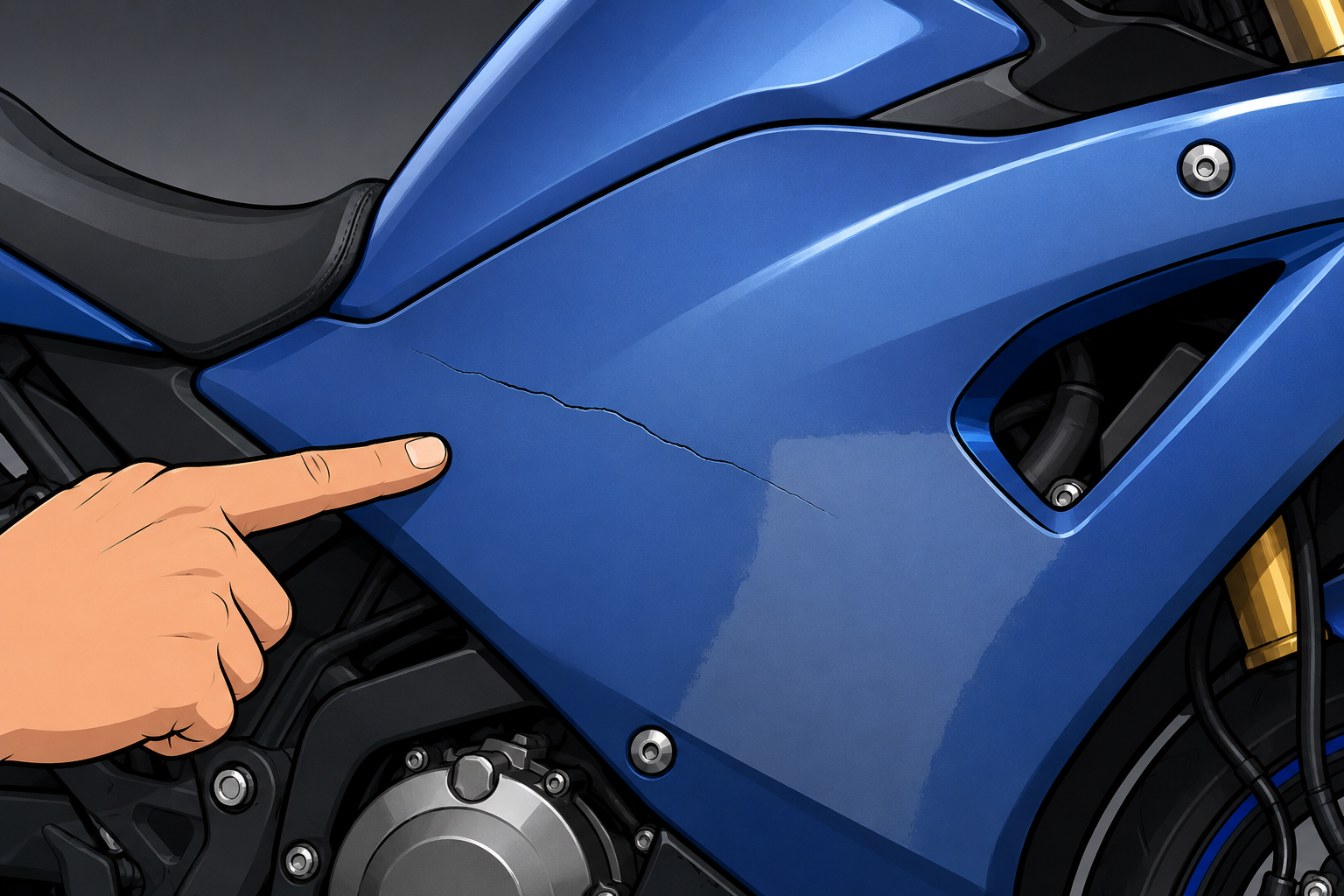
2Fairings & Body Panels
Why it matters. Cracked, mismatched or badly fitted bodywork is often the first visible evidence of a crash or careless storage.
What to check
- Look for cracks, deep scratches and scuffs, especially on lower edges and panel corners.
- Check for repaint signs: overspray, masking lines, mismatched color or texture.
- Make sure panels line up evenly, with no missing bolts, broken tabs or zip-tie repairs.
🚩 Walk away if: panels bolted to the frame are misaligned, or the damage points to a hard crash.
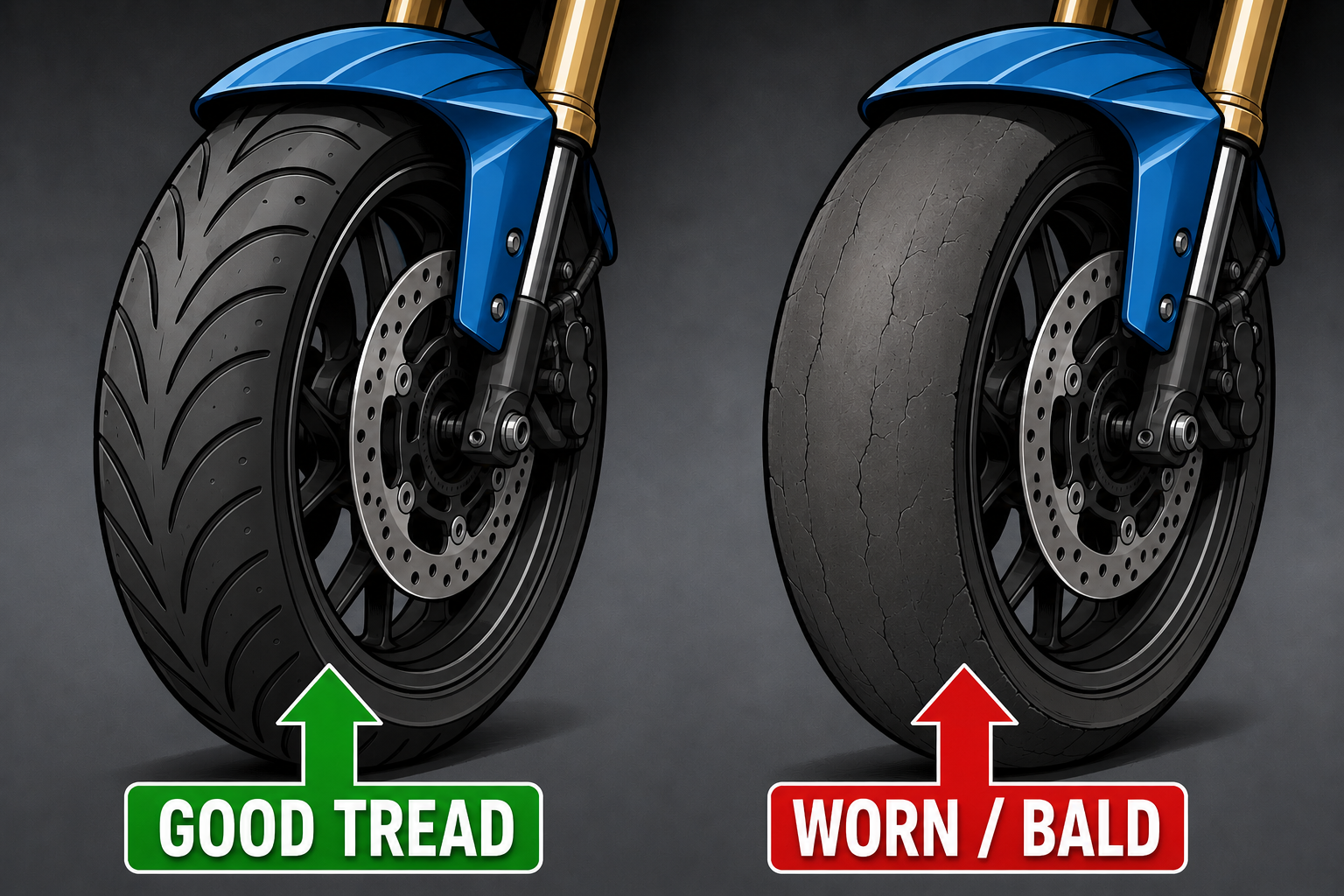
3Front Tire & Wheel
Why it matters. The front tire and rim carry your braking and steering. Worn or damaged ones are both a safety risk and a cost.
What to check
- Check tread depth at the wear bars, and look for uneven or flat-spotted wear.
- Inspect for cracks, dry rot and the date code. Tires over 5 to 6 years old are hard and unsafe even with tread.
- Look closely at the rim for dents, bends, cracks or wobble.
🚩 Walk away if: the rim is cracked or bent, or the tire cords are showing.
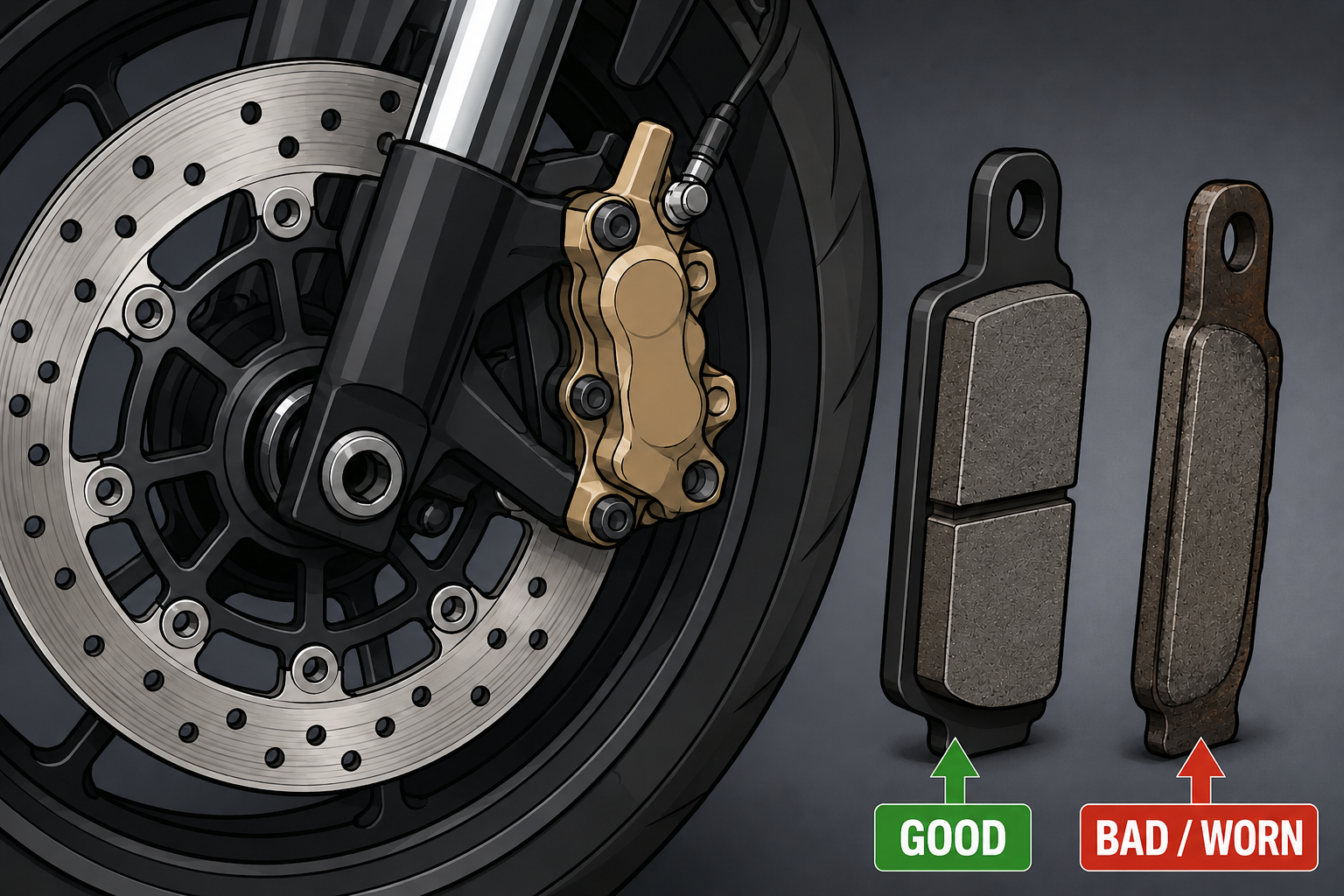
4Front Brakes
Why it matters. Brakes are not the place to save money. Worn pads and scored discs cut your stopping power and cost real money to fix.
What to check
- Check brake pad thickness, and replace it soon if under about 2 to 3 mm of material.
- Feel the disc for deep grooves and a worn lip; squeeze the lever. It should be firm, not spongy.
- Check the brake fluid level and color (dark fluid is old), and look for leaks at the caliper and hoses.
🚩 Walk away if: the lever pulls back to the bar, the disc is badly scored, or a caliper is leaking.
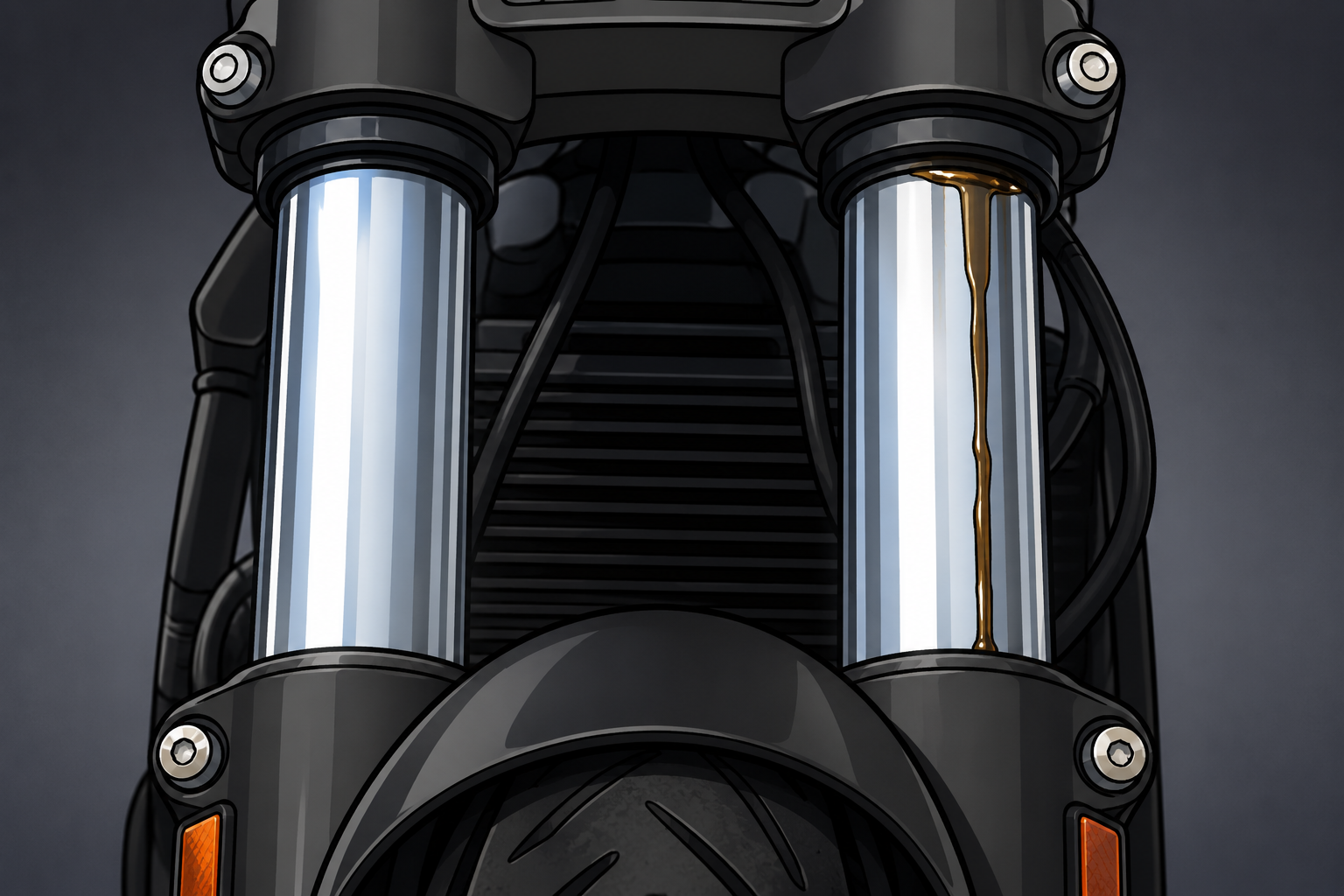
5Front Forks & Seals
Why it matters. Leaking or damaged forks ruin handling and braking, and seals, oil and tubes add up to an expensive repair.
What to check
- Inspect the fork tubes for pitting, rust and scratches above the seals.
- Look for oil on the tubes or seals. A shiny, wet film means the seals are leaking.
- Press down hard on the handlebars: the forks should compress smoothly and rebound without clunking.
🚩 Walk away if: a fork tube is bent or heavily pitted, or both seals are leaking.
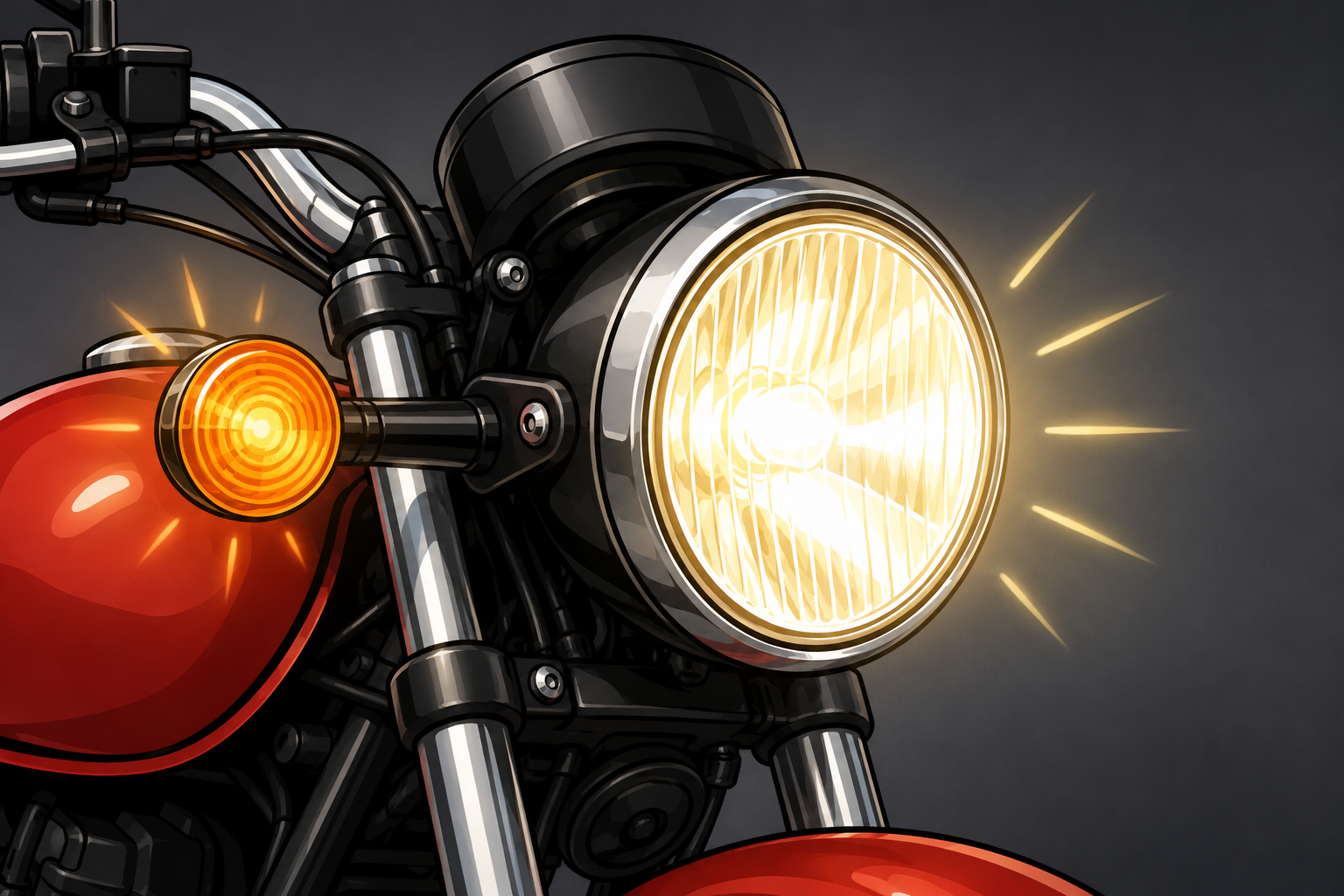
6Headlight & Indicators
Why it matters. Every light must work, for your safety, for being seen, and to stay road-legal.
What to check
- Test high and low beam, the tail light, the brake light (front lever and rear pedal) and all four indicators.
- Try the horn, and the hazard lights if fitted.
- Check for cracked lenses, water or condensation inside the units, and loose or broken mounts.
🚩 Walk away if: several electrical items are dead at once, which often points to a wiring or loom problem.
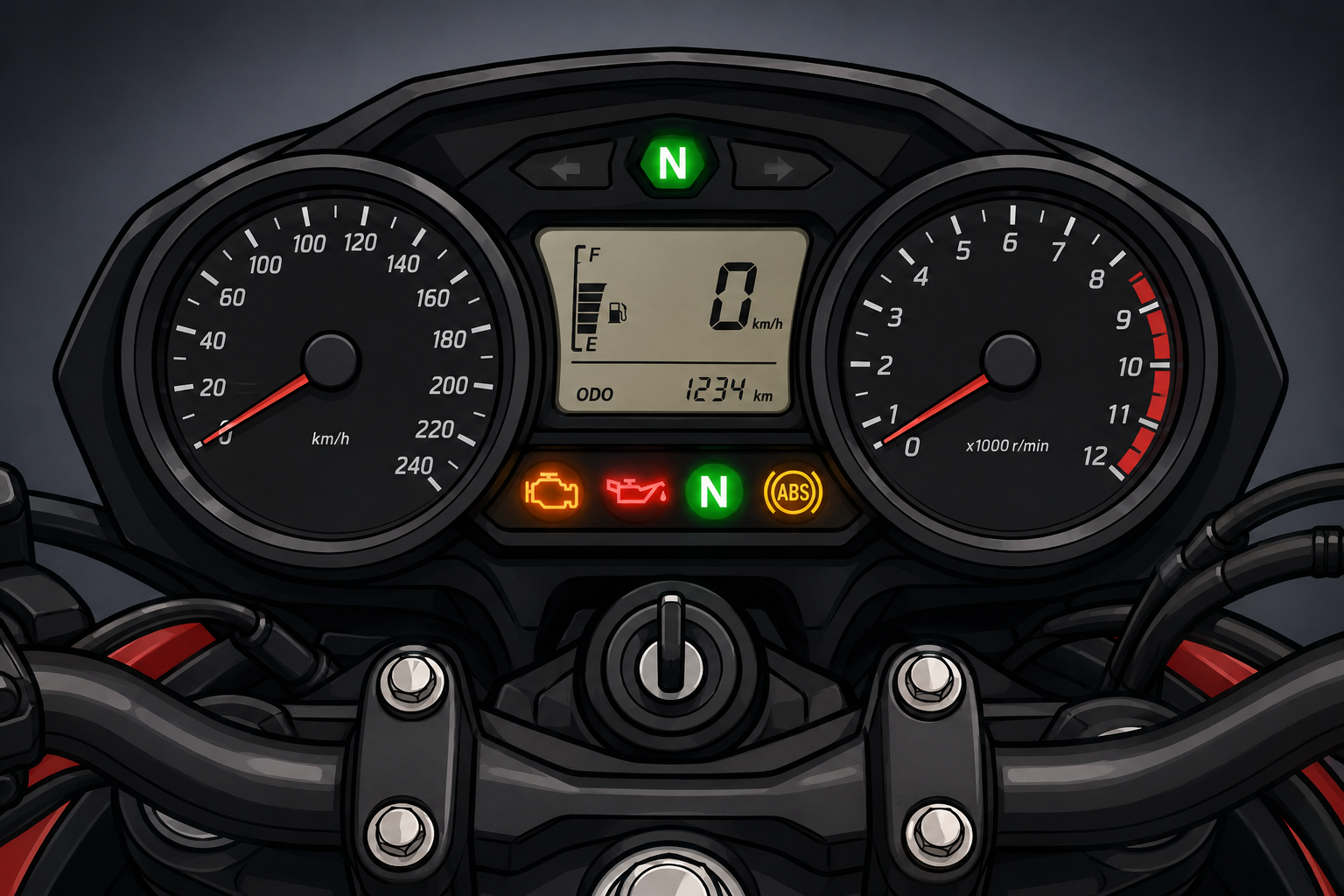
7Cockpit & Dashboard Lights
Why it matters. When you switch on the ignition the dashboard runs a self-check. It tells you whether the bike's sensors and electronics are healthy.
What to check
- Turn the ignition ON with the engine off: the warning lights should all light up.
- Start the engine: lights such as ABS, oil and engine should switch OFF shortly after.
- A light that never appears may be a removed bulb hiding a fault; one that stays on means an active fault.
🚩 Walk away if: the ABS or engine-management light stays on, or a warning bulb is suspiciously missing.
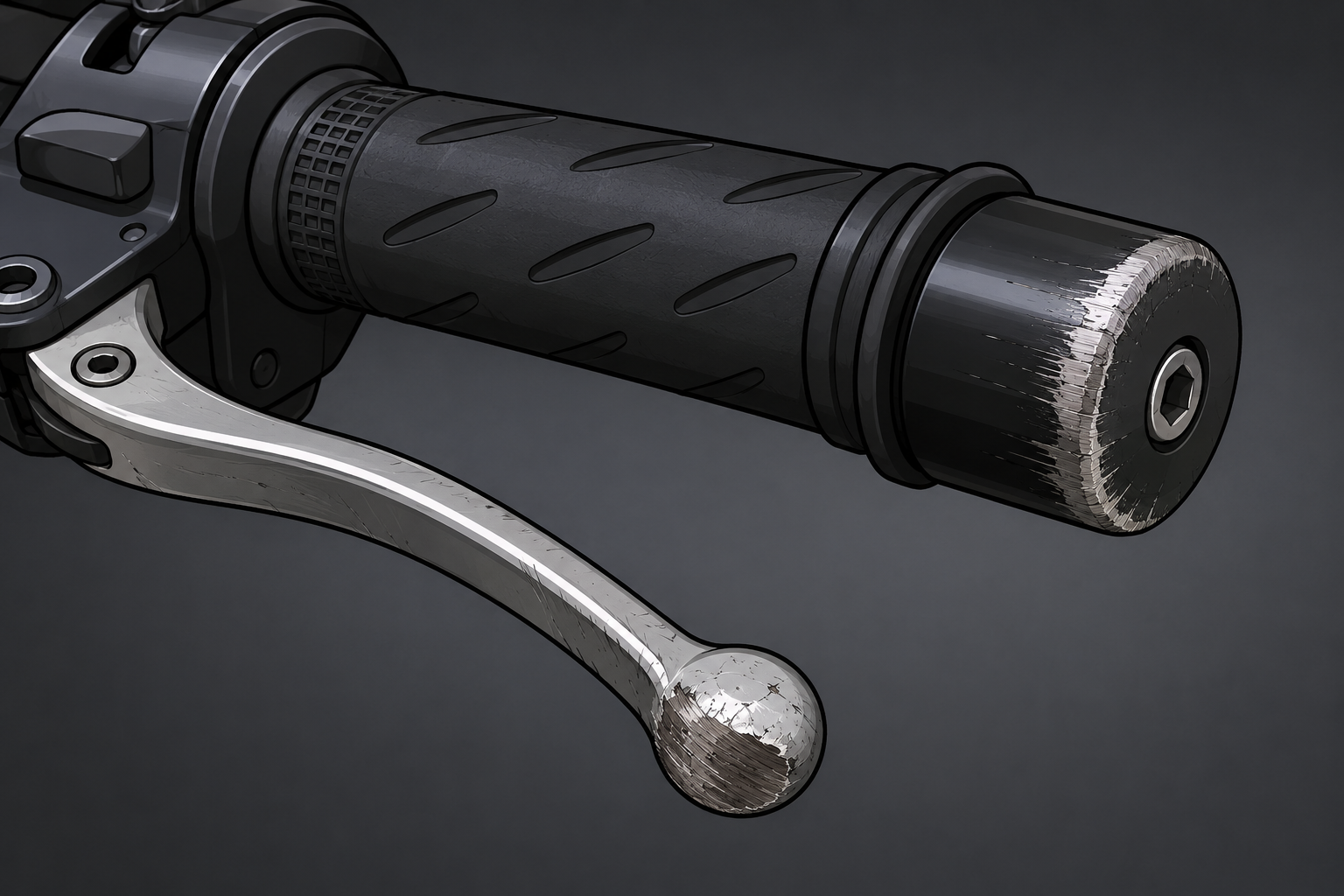
8Levers & Controls
Why it matters. Levers and bar-ends are the first things to hit the ground in a fall, so they often reveal a drop the seller never mentioned.
What to check
- Look closely at the clutch and brake lever tips and the bar-end weights for grinding, scuffs or bends.
- Check the grips and switchgear for uneven wear, and make sure every switch clicks properly.
- Roll the throttle fully. It must snap back closed on its own with no stickiness.
🚩 Walk away if: the lever tips are ground flat but the seller denies the bike was ever dropped.
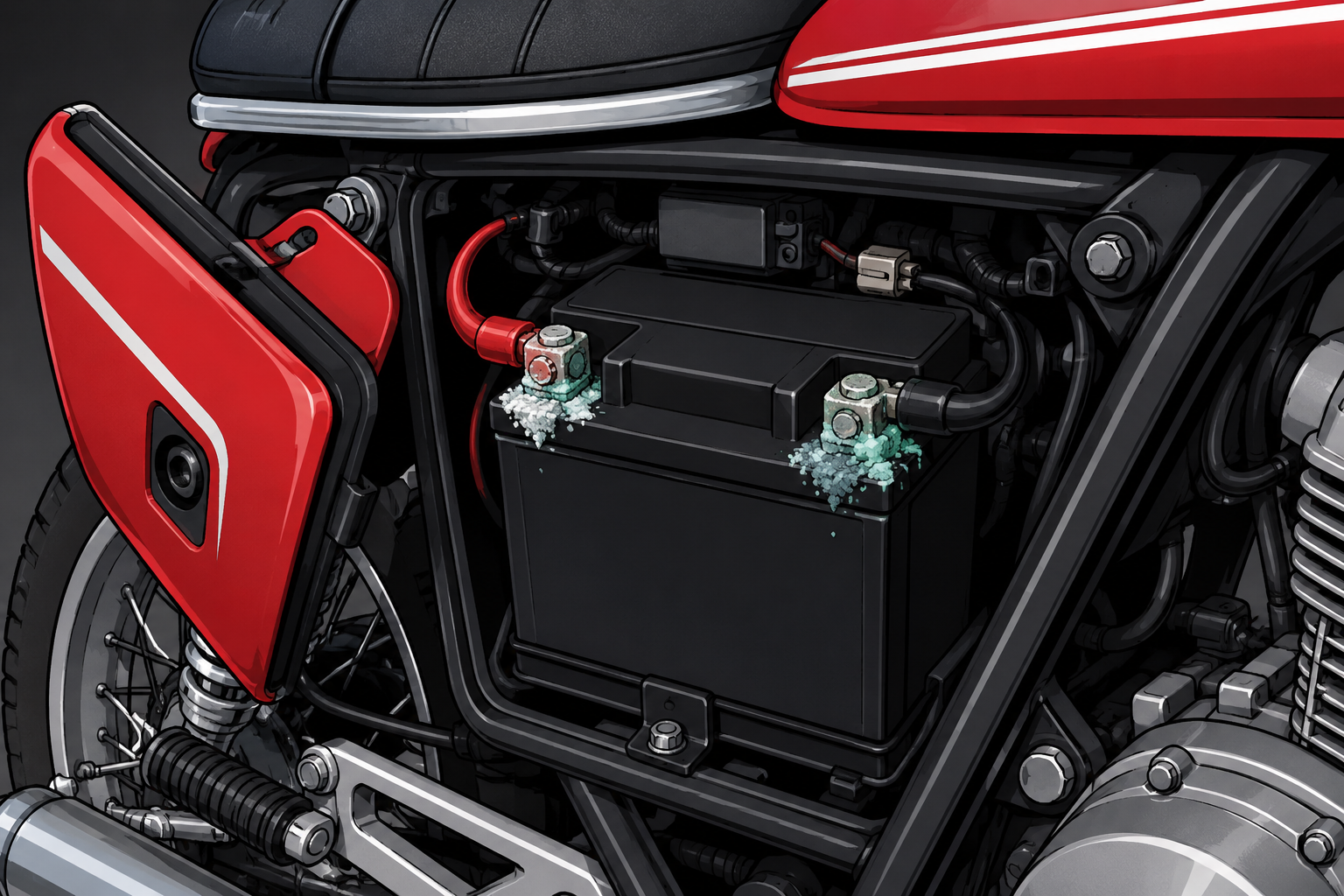
9Battery & Electronics (Left Side)
Why it matters. A weak battery or poor electrical connections cause hard starts, dim lights and dead controls.
What to check
- Check the battery terminals for corrosion, and make sure the battery is held down securely.
- Listen to the starter. It should crank strong and fast, not slow and lazy.
- Test every left-side switch: indicators, horn, beam and kill switch.
🚩 Walk away if: the engine cranks slowly, terminals are heavily corroded, or there are signs of a recent jump-start.
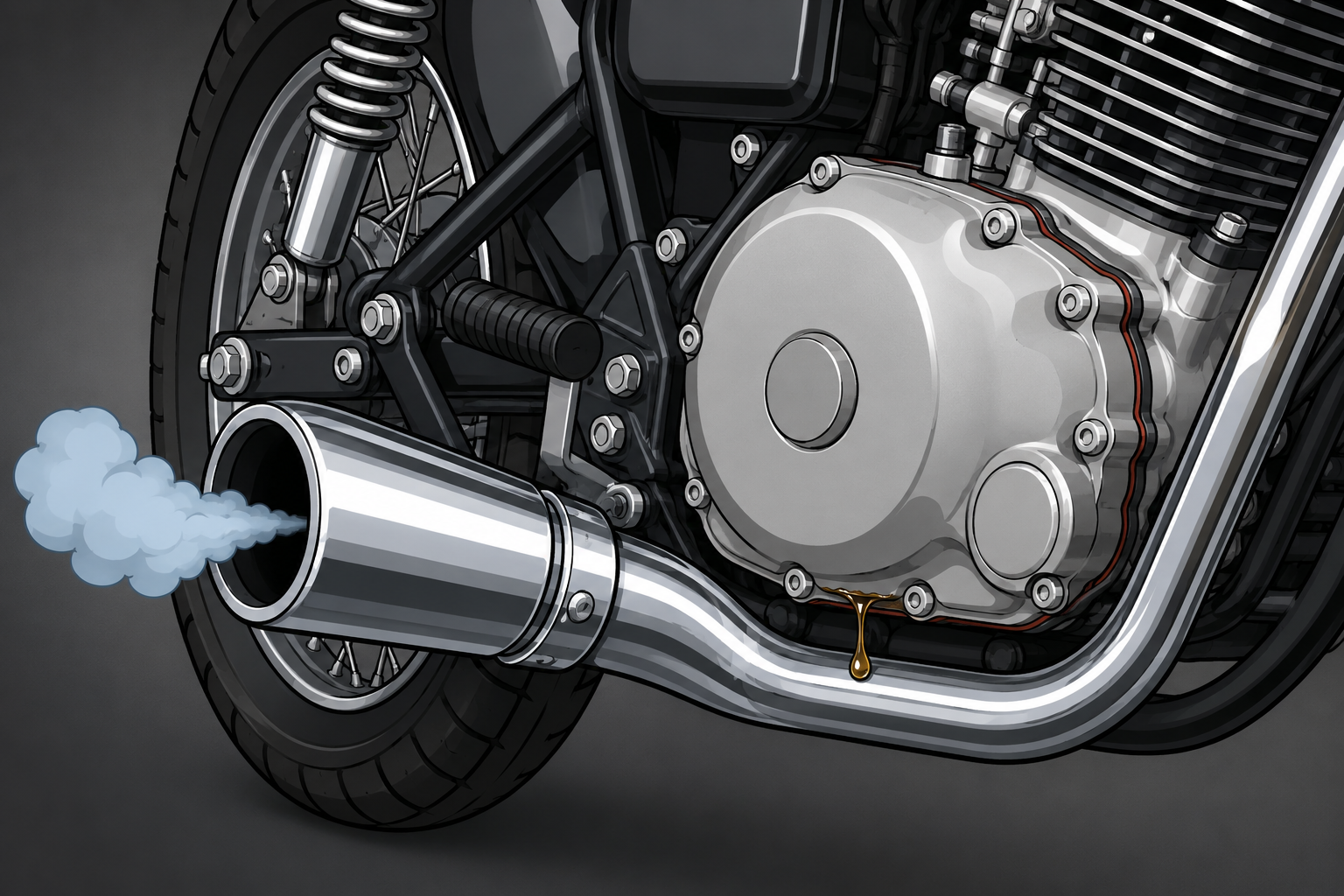
10Engine & Exhaust (Right Side)
Why it matters. This is the heart of the bike. Leaks, smoke and strange noises here are the most expensive problems to fix.
What to check
- Look for oil leaks around gaskets and cases; check the oil level and color: amber is good, black is old, milky means water in the oil.
- On liquid-cooled bikes check the coolant; inspect the exhaust for holes, heavy rust and crude repairs.
- Watch the exhaust on start-up: blue smoke = burning oil, white = coolant, black = running rich. Listen for knocks and rattles.
🚩 Walk away if: the oil is milky, there is heavy blue smoke, or you hear deep knocking from the engine.
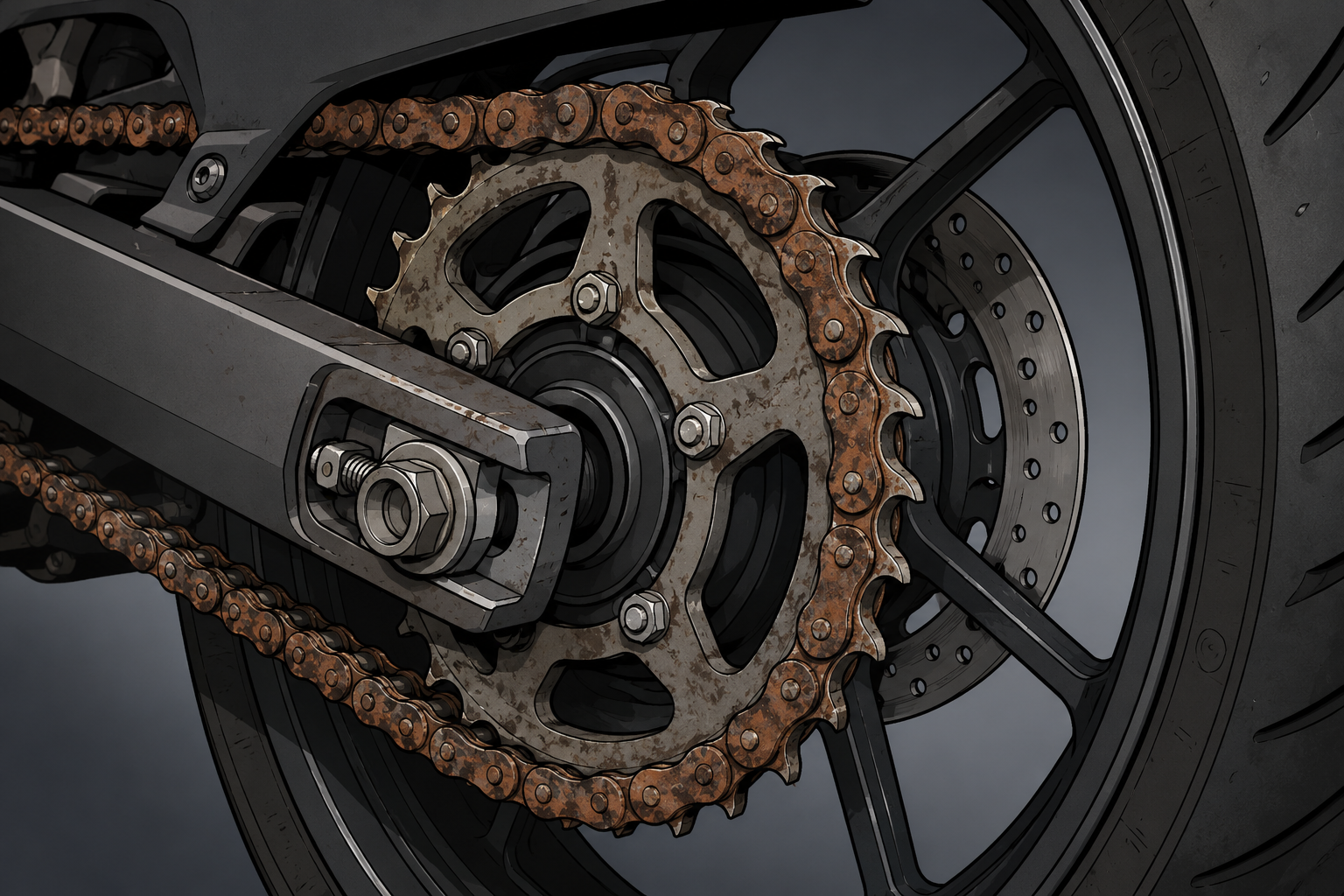
11Chain, Sprockets & Rear Tire
Why it matters. The chain and sprockets show how well the bike was maintained, and a worn set is a costly job.
What to check
- Check the chain for rust, stiff or kinked links, correct slack and signs of lubrication.
- Inspect the sprocket teeth. Hooked or pointed teeth mean the set is worn out (chain and sprockets are replaced together).
- Check the rear tire tread, wear pattern and date code, and the rear rim for damage.
🚩 Walk away if: hooked sprocket teeth and a dry, rusty chain: budget for a full chain-and-sprocket set.
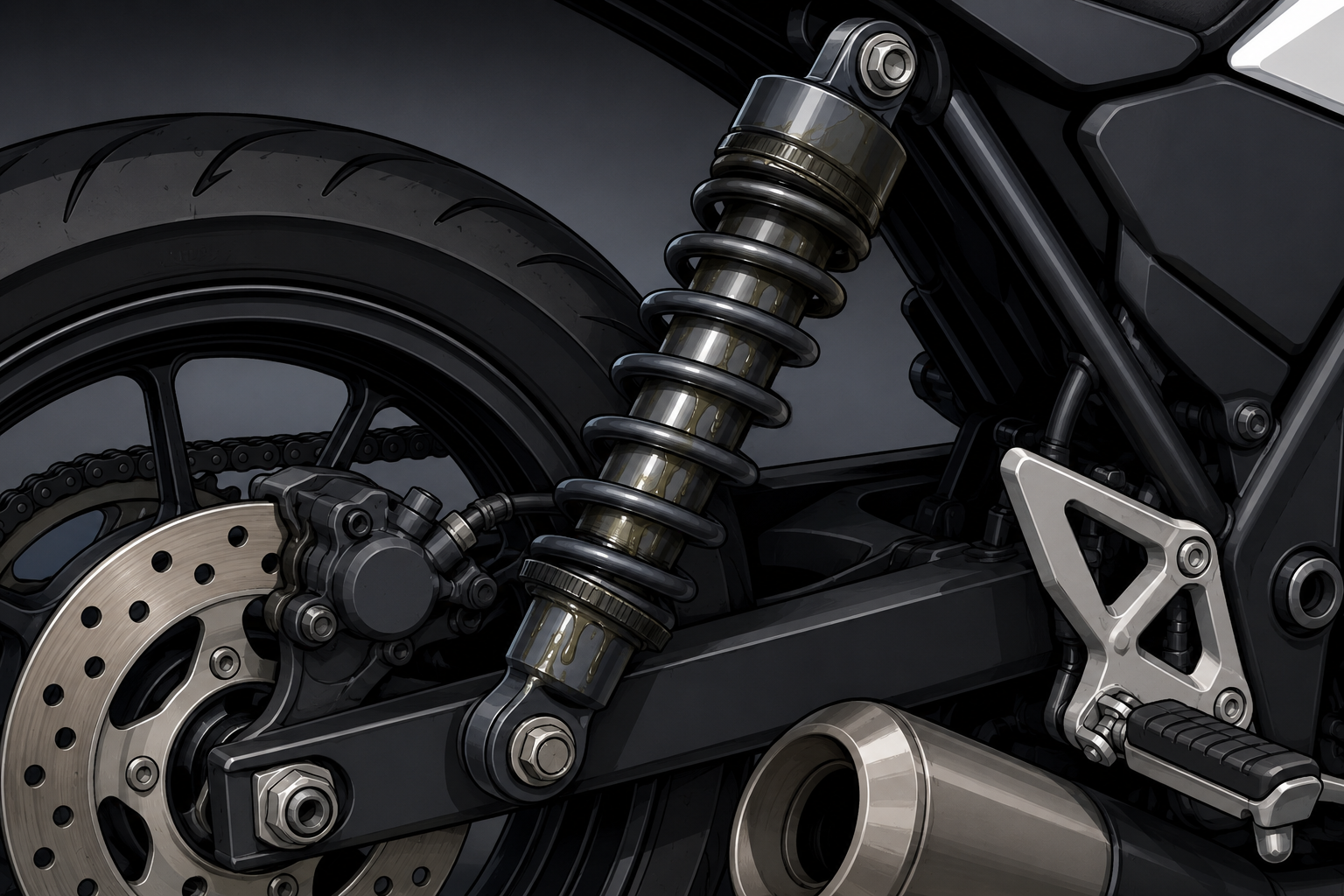
12Rear Brakes & Suspension
Why it matters. A tired rear shock or fading rear brake hurts stability, and neither is cheap to put right.
What to check
- Check the rear pad and disc, and the feel of the rear brake pedal.
- Look for oil leaking from the rear shock, and check it has not sagged out.
- Bounce the rear of the bike. It should settle in one smooth rebound; rock the rear wheel to feel for loose swingarm or linkage bearings.
🚩 Walk away if: the shock is leaking oil, or the swingarm and linkage feel loose and sloppy.
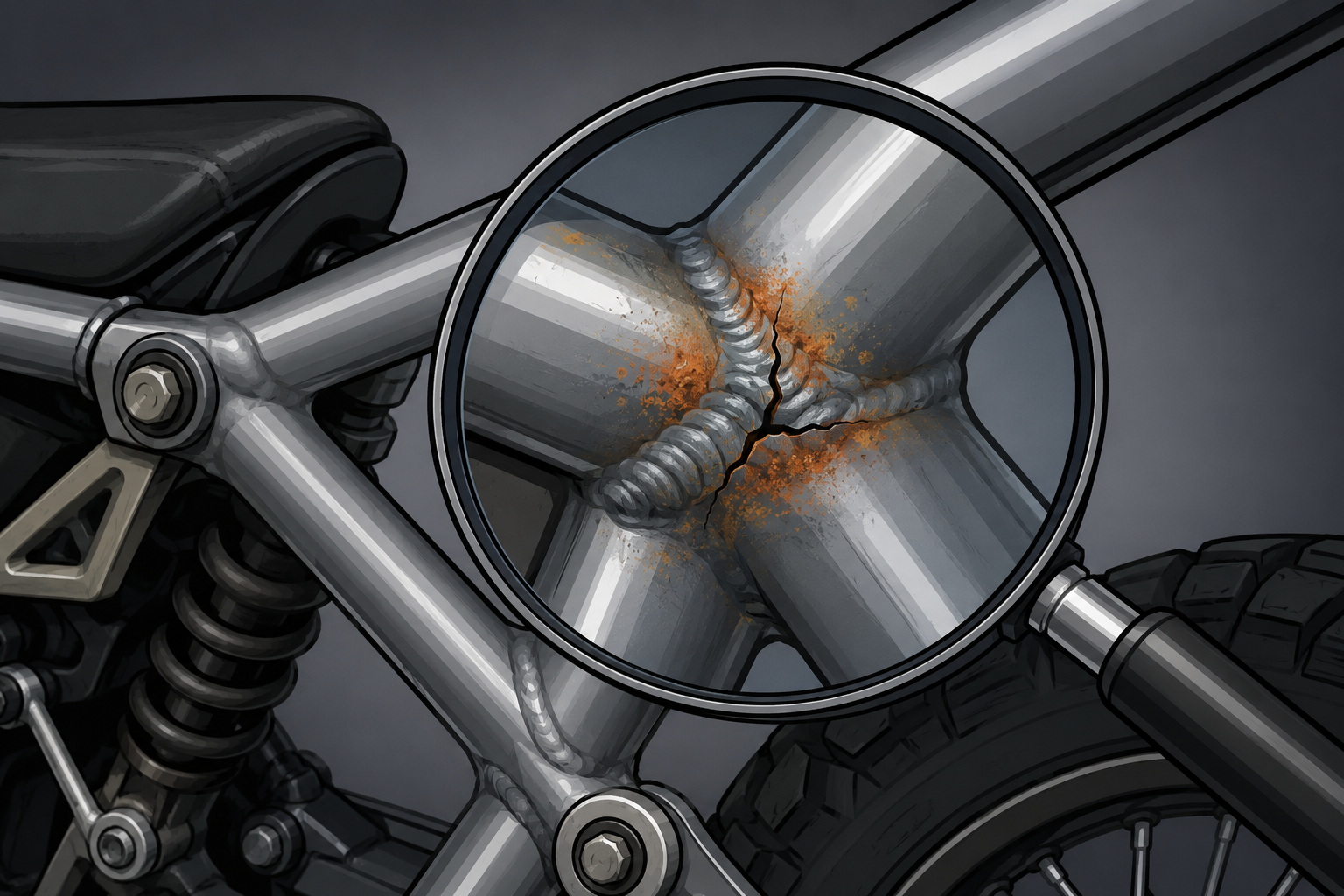
13Frame & Rust Check
Why it matters. The frame is the one part you cannot safely repair or compromise on. Damage here is an instant dealbreaker.
What to check
- Inspect the frame around the welds, the headstock and all mounting points for cracks, dents and rust.
- Look for repaint or filler hiding a repair, and for ripples that suggest a straightened frame.
- With the front brake held, rock the bike and turn the bars lock-to-lock. The steering should feel smooth, with no play or notchy spots.
🚩 Walk away immediately if: you find a cracked frame, rust at the welds, or any sign the frame was straightened.
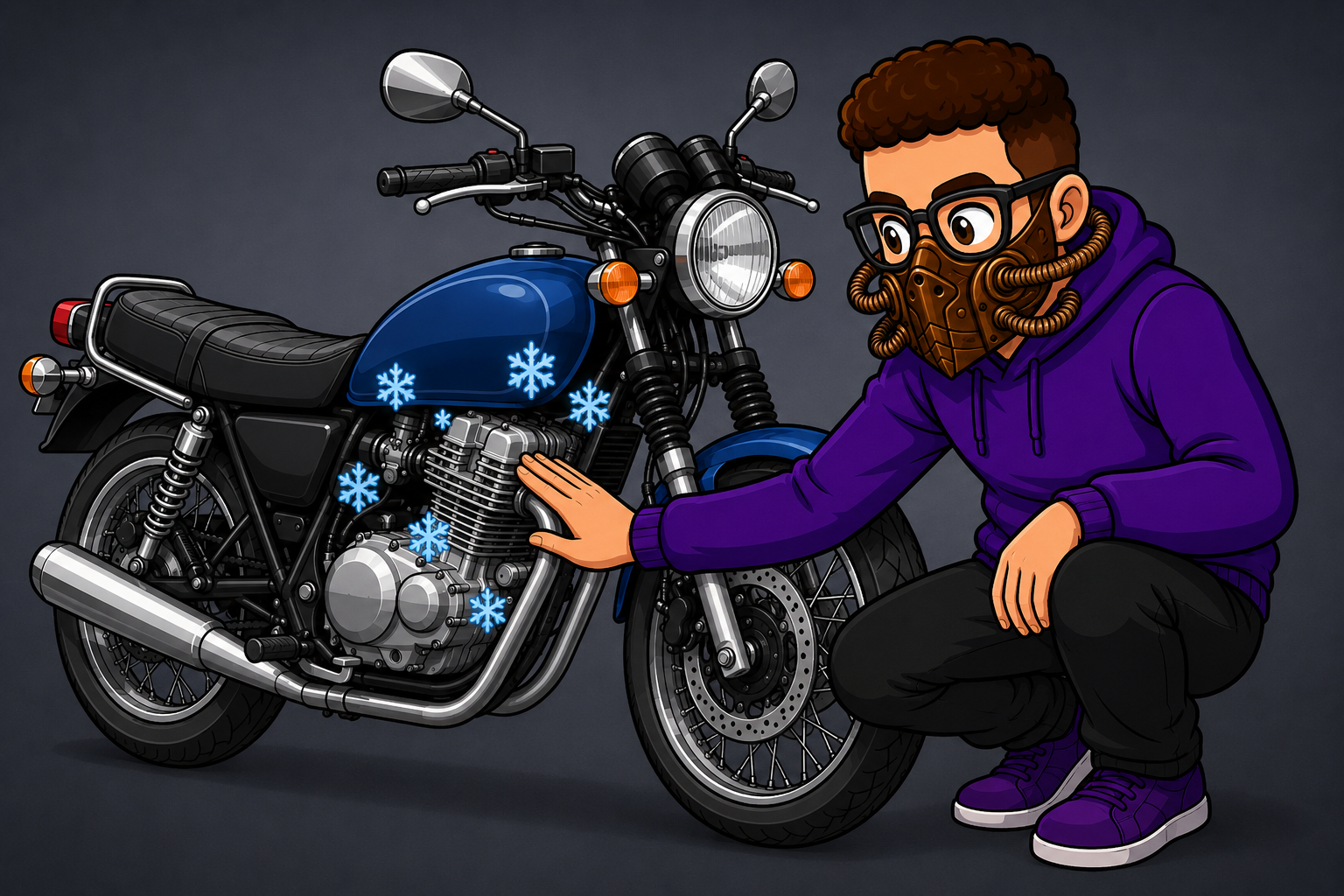
14Cold Start Test
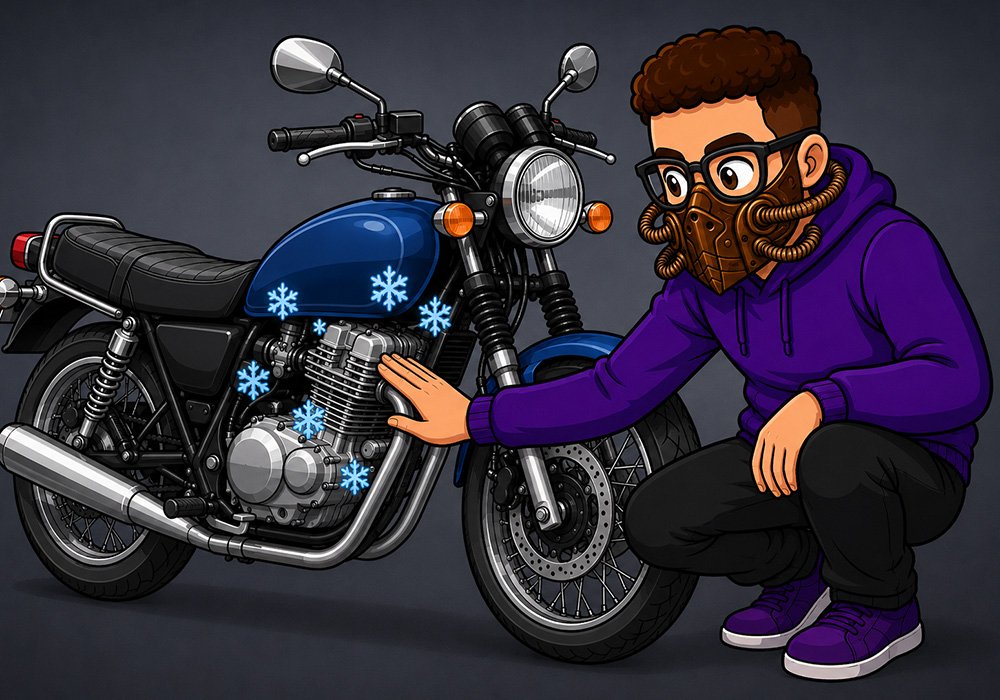
Why it matters. A warmed-up engine hides cold-start problems. The bike must be stone cold when you arrive.
What to check
- Touch the engine and exhaust before anything else. They should be completely cold.
- Start it cold: it should fire with little cranking and settle to a steady idle.
- Watch for heavy smoke, and listen for rattles that fade as it warms up.
🚩 Walk away if: the seller pre-warmed the engine and can't explain why, or it needs lots of cranking and throttle to stay running.
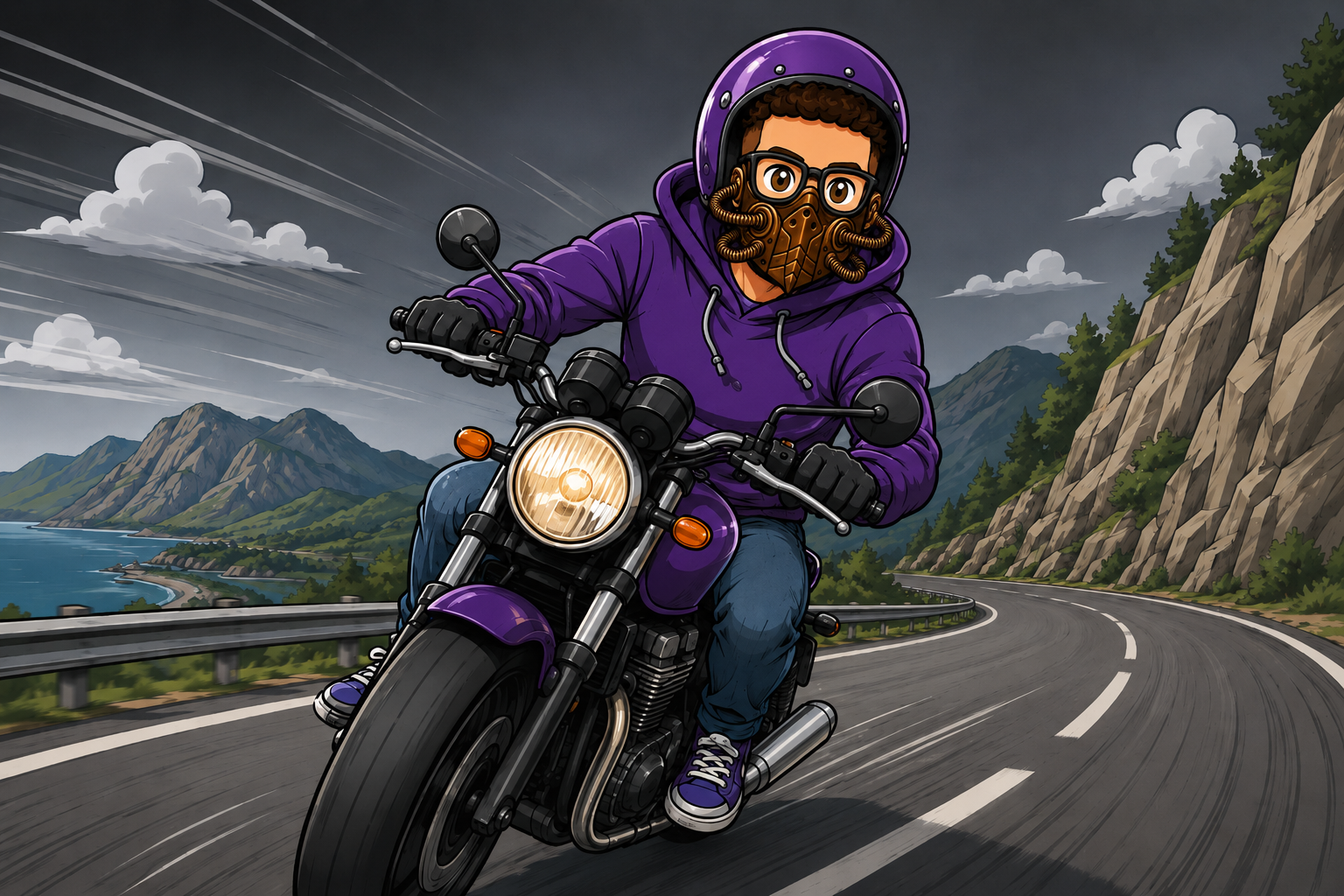
15Test Ride Feel (Clutch & Gears)
Why it matters. Only a ride reveals how the clutch, gearbox and chassis really behave under load.
What to check
- Check the clutch: if the revs climb but speed does not follow, the clutch is slipping.
- Shift through every gear. They should engage cleanly, with no false neutrals and no jumping out of gear.
- Make sure the bike tracks straight, the brakes pull straight, and there is no wobble or heavy vibration.
🚩 Walk away if: the clutch slips, the gearbox jumps out of gear, or you feel a wobble in the frame.
Only test-ride with proper gear, with the seller's agreement, and where it is safe and legal.
16Papers & VIN Match
Why it matters. Even a perfect bike is worthless to you if the paperwork doesn't add up, or if it isn't really the seller's to sell.
What to check
- Check the frame VIN matches the registration or title exactly, and that the engine number matches the papers.
- Confirm the seller's ID matches the name on the documents, and ask about any outstanding finance or loan.
- Make sure the VIN plate has not been re-riveted, scratched or tampered with.
🚩 Walk away if: the VIN doesn't match, the seller isn't the registered owner, or the VIN plate looks tampered with.
Full legal and paperwork guidance is coming in a separate goutchen.com article.
Scoring your bikes
As you inspect each bike, give every one of the 16 points a score out of 10:
- 9 to 10: as-new or excellent condition.
- 7 to 8: normal wear for a used bike, nothing to worry about.
- 4 to 6: needs attention or repair soon. Use it to negotiate the price.
- 0 to 3: a serious problem, expensive to fix, or a safety risk.
Add up all 16 scores for a total out of 160. Then read the verdict below.
| Total score | What it means |
|---|---|
| 140 to 160 | Excellent. A well-cared-for bike. Buy with confidence (paperwork permitting). |
| 110 to 139 | Good. Normal used-bike wear. Negotiate on the weaker points. |
| 80 to 109 | Caution. Several issues. Add up the repair costs and subtract them from your offer. |
| Below 80 | Walk away. Too many problems; the hidden costs will likely outweigh the savings. |
Any single "Walk away if..." red flag in this guide is a dealbreaker on its own, no matter how high the total. A cracked frame, a mismatched VIN or milky engine oil should end the deal even on an otherwise great bike.
Save it, print it, take it with you:
Found this useful? Share it, and ride safe.
For more buying guides, riding tips and motorcycle content:
▶ YouTube: Goutchen Rider · 📷 Instagram: @dagoutchen